






 Choose language
- Spiders
- ANIMALS
- Arachnids (Arachnida)
- Spiders (Araneae)
- Tarantulas (Mygalomorphae)
- Psednocnemis spp.
- Diplura spp.
- Spinosatibiapalpus spp.
- Acanthogonatus spp.
- Acanthoscurria spp.
- Amazonius spp.
- Ami spp.
- Anquasha spp.
- Aphonopelma spp.
- Aspinochilus spp.
- Augacephalus spp.
- Avicularia spp.
- Birupes spp.
- Bonnetina spp.
- Brachypelma spp.
- Bumba spp.
- Caribena spp.
- Ceratogyrus spp.
- Chaetopelma spp.
- Chilobrachys spp.
- Chromatopelma spp.
- Cilantica spp.
- Citharacanthus spp.
- Coremiocnemis spp.
- Cyclosternum spp.
- Cyriocosmus spp.
- Cyriopagopus spp.
- Davus spp.
- Dolichothele spp.
- Encyocratella spp.
- Ephebopus spp.
- Euathlus spp.
- Eucratoscelus spp.
- Eupalaestrus spp.
- Fufius spp.
- Gorgyrella spp.
- Grammostola spp.
- Guyruita spp.
- Hapalopus spp.
- Haploclastus spp.
- Haplocosmia spp.
- Haplopelma spp.
- Harpactira spp.
- Heteroscodra spp.
- Heterothele spp.
- Holothele spp.
- Homoeomma spp.
- Hysterocrates spp.
- Idiothele spp.
- Iridopelma spp.
- Kochiana spp.
- Lampropelma spp.
- Lasiocyano spp.
- Lasiodora spp.
- Lasiodorides spp.
- Linothele spp.
- Lyrognathus spp.
- Megaphobema spp.
- Monocentropus spp.
- Neischnocolus spp.
- Neoholothele spp.
- Neostenotarsus spp.
- Nhandu spp.
- Omothymus spp.
- Ornithoctoninae spp.
- Ornithoctonus spp.
- Pamphobeteus spp.
- Pelinobius spp.
- Phormictopus spp.
- Phormingochilus spp.
- Phrixotrichus spp.
- Poecilotheria spp.
- Psalmopoeus spp.
- Pseudhapalopus spp.
- Pseudoclamoris spp.
- Pterinochilus spp.
- Selenocosmia spp.
- Sericopelma spp.
- Tapinauchenius spp.
- Taksinus spp.
- Tapinauchenius spp.
- Theraphosa spp.
- Theraphosidae spp.
- Theraphosinae spp.
- Thrigmopoeus spp.
- Thrixopelma spp.
- Tliltocatl spp.
- Typhochlaena spp.
- Urupelma spp.
- Vitalius spp.
- Xenesthis spp.
- Ybyrapora spp.
- True Spiders (Araneomorphae)
- Velvet Spiders (Eresidae)
- Macrothele spp.
- Liphistius spp.
- Tarantulas (Mygalomorphae)
- Scorpions (Scorpiones)
- Spiders (Araneae)
- Insects - for feeding
- Arachnids (Arachnida)
- Scorpions
- Accessories
- Books
- Centipede
- Millipede
- Cockroaches
- New products
- Products on sale
Currency

€32.00
Regular price:
€40.00

€42.50
Regular price:
€50.00
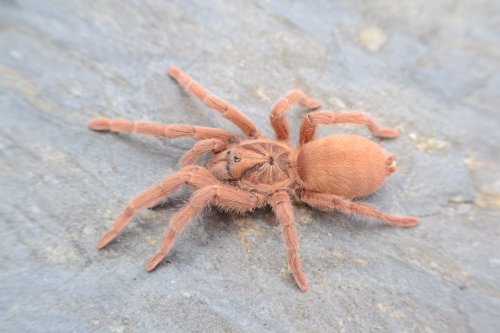


Species: Neoholothele incei "gold"
Common name: Trinidad Olive (gold form)
Native range: Trinidad and Tobago
Temperature: 24–28°C, with a 2–3°C drop at night; room temperature is generally sufficient
Humidity: 70–80%
Adult size: Females reach up to 4 cm BL
Lifestyle: Terrestrial / semi-arboreal (heavy webber)
Speed: Fast
Venom potency: Mild
Temperament: Calm
Recommended for: Suitable for all keepers, including those new to communal setups
Notes: Does not require CITES documentation. One of the few reliably communal tarantulas in the hobby.
Neoholothele incei gold
product unavailable
Description
Few tarantulas let you watch a society unfold inside a glass box. Neoholothele incei gold is one of them — a small, communal species from Trinidad and Tobago that genuinely tolerates its own kind, sharing silk, space, and prey in a way that runs counter to almost everything else in Theraphosidae. The gold colour form trades the olive tones of the standard expression for warm amber and gold-brown, finely banded along the walking legs. It is a compact, lightly built spider, but the appeal sits less in the colour than in what the colour is doing inside a colony.
Communal living among tarantulas is rare enough to be notable, and Neoholothele incei gold does it convincingly. Several individuals will share an interlocking web architecture, reinforce shared retreats with dense silk, and on a good feeding night converge on the same prey item together — closer to field observation than routine husbandry. They are quick, alert, and prolific weavers, and a well-established group develops a layered silk network that is genuinely interesting to watch take shape.
A semi-arboreal setup works well: 5–7 cm of coconut fibre substrate with cork bark set at an angle or vertically to provide climbing structure and anchor points for webbing. For three or four spiders, an enclosure with a base of at least 30×30 cm gives each animal room to negotiate territory while the colony's silk network develops naturally. Keep humidity moderate to high with regular misting, provide a water dish for adults, and aim for 24–28°C — standard room temperature in most homes is fine, no supplemental heating required. Feeding scales with the group: offer prey in proportion to the number of spiders, not the appetite of one.
Keep Neoholothele incei gold for a year and you stop thinking of tarantulas as solitary animals. The colony becomes a slow, ongoing study in silk-building, prey response, and spatial negotiation between animals the rest of the hobby assumes are fundamentally alone. It asks for no specialist experience, no unusual equipment, no rare conditions — just a willingness to set up one enclosure differently and watch what happens. The gold colour is what catches your eye on the shelf; the pack dynamics are what keep the enclosure on your rack five years later.