






 Choose language
- Spiders
- ANIMALS
- Arachnids (Arachnida)
- Spiders (Araneae)
- Tarantulas (Mygalomorphae)
- Psednocnemis spp.
- Diplura spp.
- Spinosatibiapalpus spp.
- Acanthogonatus spp.
- Acanthoscurria spp.
- Amazonius spp.
- Ami spp.
- Anquasha spp.
- Aphonopelma spp.
- Aspinochilus spp.
- Augacephalus spp.
- Avicularia spp.
- Birupes spp.
- Bonnetina spp.
- Brachypelma spp.
- Bumba spp.
- Caribena spp.
- Ceratogyrus spp.
- Chaetopelma spp.
- Chilobrachys spp.
- Chromatopelma spp.
- Cilantica spp.
- Citharacanthus spp.
- Coremiocnemis spp.
- Cyclosternum spp.
- Cyriocosmus spp.
- Cyriopagopus spp.
- Davus spp.
- Dolichothele spp.
- Encyocratella spp.
- Ephebopus spp.
- Euathlus spp.
- Eucratoscelus spp.
- Eupalaestrus spp.
- Fufius spp.
- Gorgyrella spp.
- Grammostola spp.
- Guyruita spp.
- Hapalopus spp.
- Haploclastus spp.
- Haplocosmia spp.
- Haplopelma spp.
- Harpactira spp.
- Heteroscodra spp.
- Heterothele spp.
- Holothele spp.
- Homoeomma spp.
- Hysterocrates spp.
- Idiothele spp.
- Iridopelma spp.
- Kochiana spp.
- Lampropelma spp.
- Lasiocyano spp.
- Lasiodora spp.
- Lasiodorides spp.
- Linothele spp.
- Lyrognathus spp.
- Megaphobema spp.
- Monocentropus spp.
- Neischnocolus spp.
- Neoholothele spp.
- Neostenotarsus spp.
- Nhandu spp.
- Omothymus spp.
- Ornithoctoninae spp.
- Ornithoctonus spp.
- Pamphobeteus spp.
- Pelinobius spp.
- Phormictopus spp.
- Phormingochilus spp.
- Phrixotrichus spp.
- Poecilotheria spp.
- Psalmopoeus spp.
- Pseudhapalopus spp.
- Pseudoclamoris spp.
- Pterinochilus spp.
- Selenocosmia spp.
- Sericopelma spp.
- Tapinauchenius spp.
- Taksinus spp.
- Tapinauchenius spp.
- Theraphosa spp.
- Theraphosidae spp.
- Theraphosinae spp.
- Thrigmopoeus spp.
- Thrixopelma spp.
- Tliltocatl spp.
- Typhochlaena spp.
- Urupelma spp.
- Vitalius spp.
- Xenesthis spp.
- Ybyrapora spp.
- True Spiders (Araneomorphae)
- Velvet Spiders (Eresidae)
- Macrothele spp.
- Liphistius spp.
- Tarantulas (Mygalomorphae)
- Scorpions (Scorpiones)
- Spiders (Araneae)
- Insects - for feeding
- Arachnids (Arachnida)
- Scorpions
- Accessories
- Books
- Centipede
- Millipede
- Cockroaches
- New products
- Products on sale
Currency

€32.00
Regular price:
€40.00

€42.50
Regular price:
€50.00
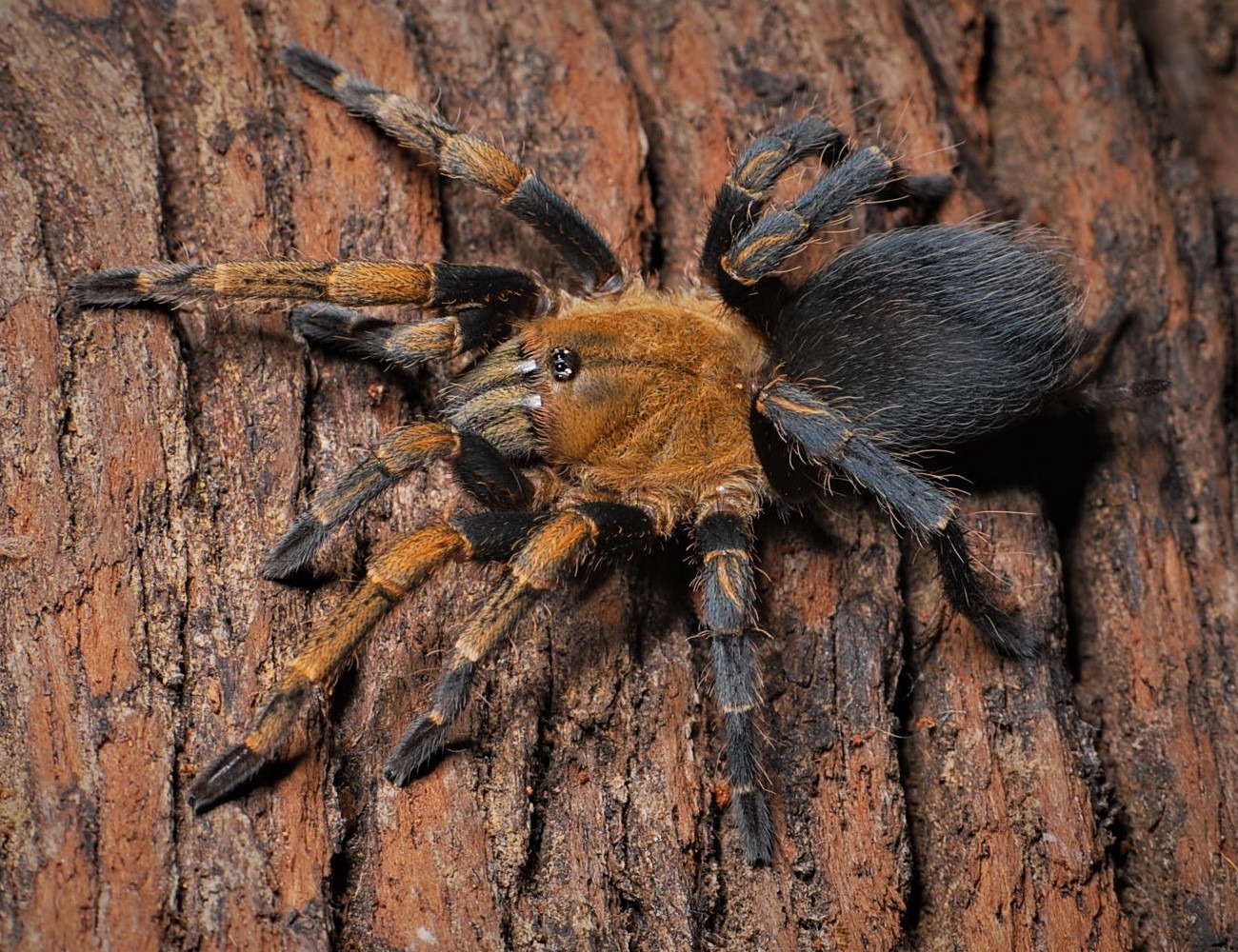
Species: Spinosatibiapalpus trinitatis
Common name: Trinidad Copper Top
Native range: Trinidad and Tobago
Temperature: 23-27°C, copes well at room temperature
Humidity: 70-80%
Adult size: Small to medium-sized tarantula; exact female size not well documented
Lifestyle: Terrestrial
Speed: Fast
Venom potency: Mild
Temperament: Skittish
Recommended for: Intermediate keepers
Notes: Not listed under CITES, no captive-breeding certificate required
Spinosatibiapalpus trinitatis
product unavailable
Description
Spinosatibiapalpus trinitatis comes from Trinidad and Tobago. Pocock described it as early as 1903, yet it remains one of the least known tarantulas in the hobby. For over a century it moved between the genera Metriopelma, Crypsidromus and Pseudhapalopus, until in 2020 it was placed in the newly erected genus Spinosatibiapalpus, named after the spines on the palps of mature males. The female was only formally described in recent years. Its common name, Trinidad Copper Top, refers to the coppery tone of the carapace. A grown specimen (pictured) shows why: a rusty-copper carapace, a velvety black abdomen and black legs banded in golden orange.
In the enclosure it is fast and skittish. It does not look for confrontation and, when disturbed, bolts for cover. Spiderlings are tiny and, according to keepers, grow slowly, so this is a long-term project in which every moult brings you closer to the full adult colouring. Like other members of the subfamily Theraphosinae it carries urticating hairs on the abdomen and may kick them off if seriously disturbed.
We offer L1 spiderlings, which do best in a small, well-ventilated container. Provide a layer of coconut fibre kept lightly moist, never wet and never fully dry, plus a small piece of cork bark as a hide. Its humid Caribbean origin translates into 70-80% humidity, easily maintained by regular misting of part of the container. Spiderlings drink droplets from the walls; a water dish only makes sense for larger specimens. Room temperature is perfectly adequate. Offer small prey matched to the spider's size. A secure hide gives a young spider confidence, and a confident spider is far more often seen at its entrance.
Spinosatibiapalpus trinitatis is for keepers who have a few tarantulas behind them and want something rare with a story. Its speed and nervous nature make it a display animal, best suited to intermediate hobbyists. It is worth keeping if only because so little is known about it, and every successful rearing adds another piece to the puzzle.