






 Choose language
Currency
Choose language
Currency

€32.00
Regular price:
€40.00

€42.50
Regular price:
€50.00
Phidippus regius Henry County
product unavailable
Description
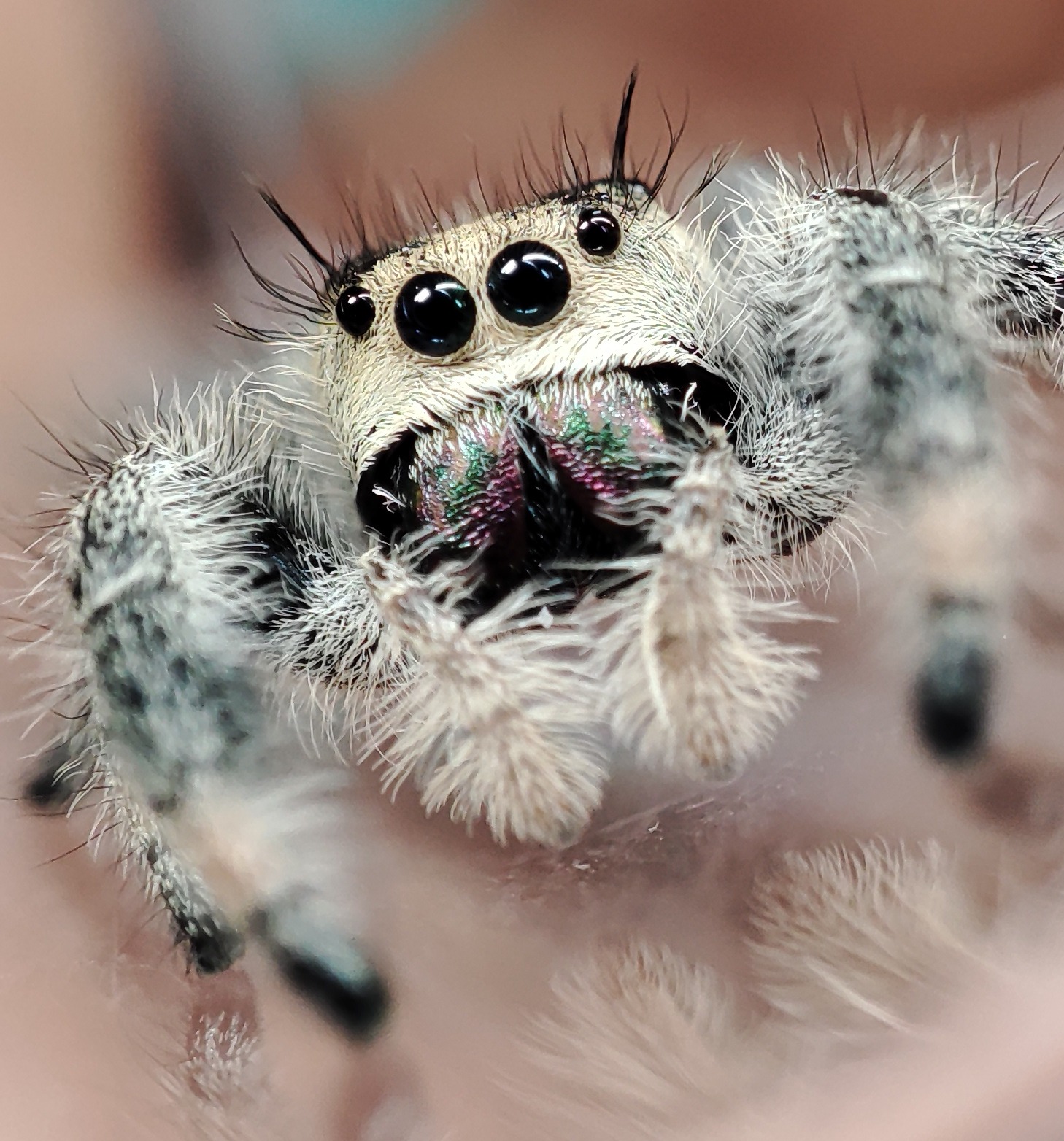
There's a moment, the first time you keep a Phidippus regius, when you realise the spider is studying you as intently as you're studying it. The Hendry County locality takes that arresting eye-contact and dresses it in autumn. Where the classic morph trades in stark black-and-white, this one runs warm — oranges, tawny browns, soft beiges, all broken by clean white accents on the walking legs and the opisthosoma. Females reveal the full depth of that amber-orange under direct light; males throw a metallic sheen off the chelicerae that catches you from almost any angle. Adults reach 12–18 mm in body length.
What you get in personality is pure Phidippus regius, and that's exactly the appeal. Diurnal, relentlessly active, hunting by sight across distances that dwarf its own body — this is a jumping spider that locks on and commits, the way a hawk does. No capture web, just a silk dragline anchoring every leap. Toward you it leans curious rather than defensive: it'll track a hand moving behind the glass and stalk appropriately sized prey with that deliberate, unhurried confidence. Dense setae give the body the plush, velvet look the genus is known for. Venom is mild and bites are rare. The Hendry County line carries all the directness and charisma of the species, simply rendered in a warmer palette — and for a great many keepers, that warmer version quietly becomes the one they prefer.
A vertical enclosure of around 15×15×20 cm suits an adult well. Cork bark, a cork tube, or artificial foliage in the upper portion gives the spider somewhere to anchor a silken retreat and, in time, a brood sac. Use two to three centimetres of coconut fibre as substrate, kept lightly moist rather than damp. Misting the enclosure walls now and then maintains moderate humidity; the substrate itself should never be wet, as excess moisture is the single most common way keepers lose jumping spiders. Room temperature is plenty. Feed with appropriately sized prey.
As a first jumping spider, the Hendry County Phidippus regius is hard to beat — and just as natural a pick for keepers who already run the classic form and want to see the genus through a warmer lens. The two side by side make an immediate, satisfying contrast: not a substitute, a complement. The clock runs faster than it does with tarantulas — females live roughly 2.5–3 years, males around 1.5–2 — so this isn't a decades-long companion. But for those few years you'll keep a spider that turns to face you across the room, and once you've kept one that watches back, the rest of the collection starts to feel a little one-sided.