






 Choose language
Currency
Choose language
Currency

€32.00
Regular price:
€40.00

€42.50
Regular price:
€50.00

Phidippus regius Florida
product unavailable
Description
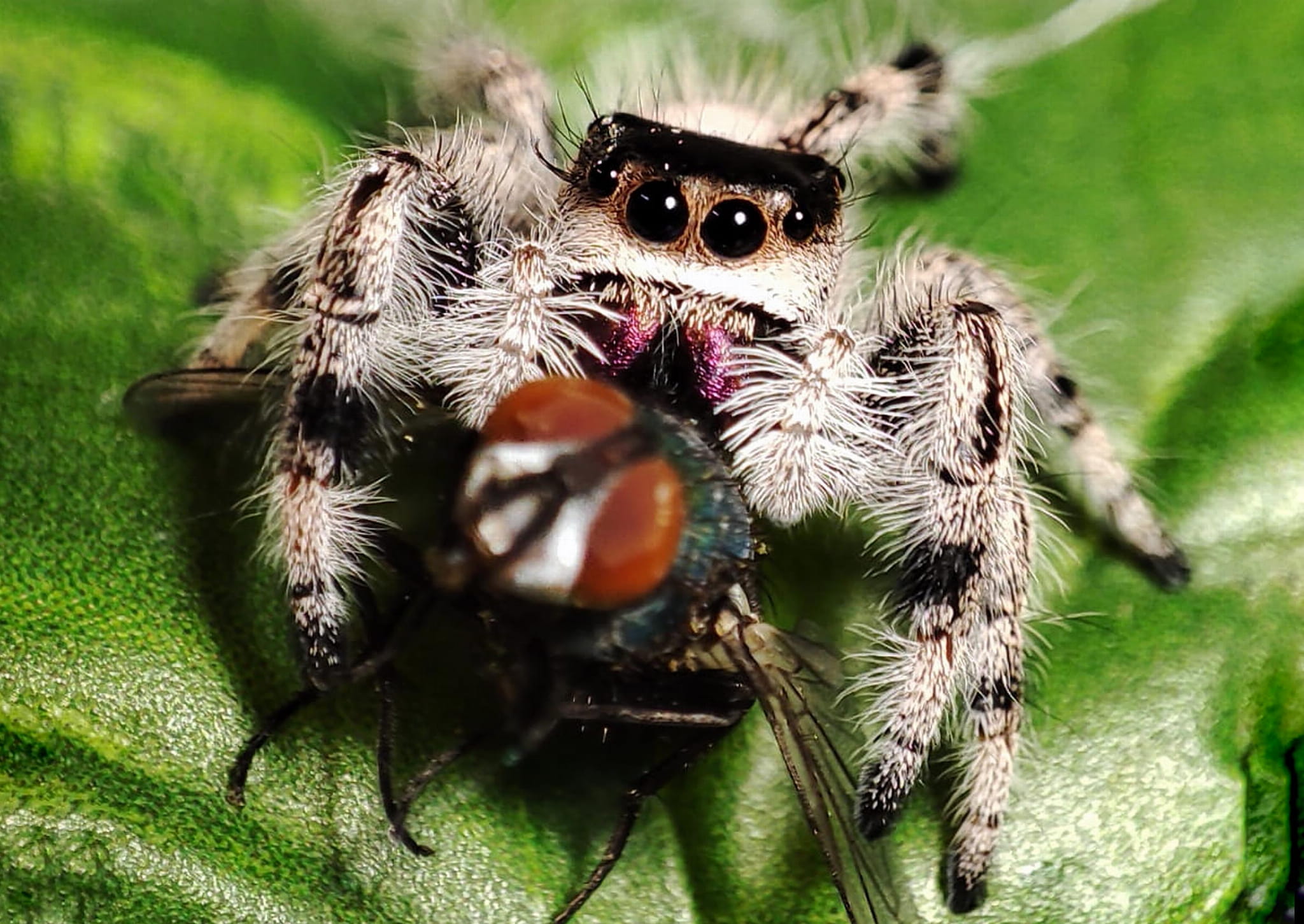
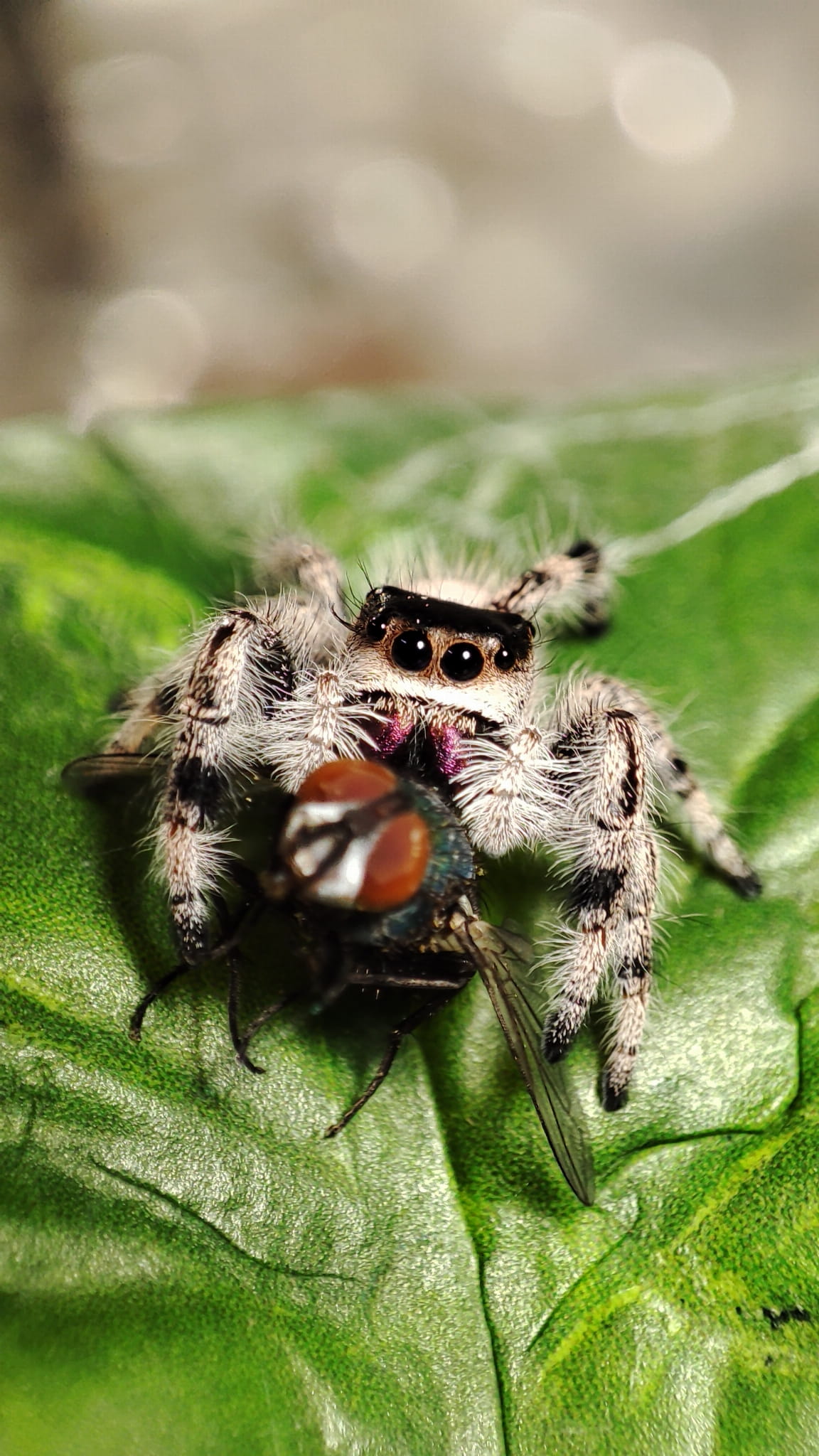
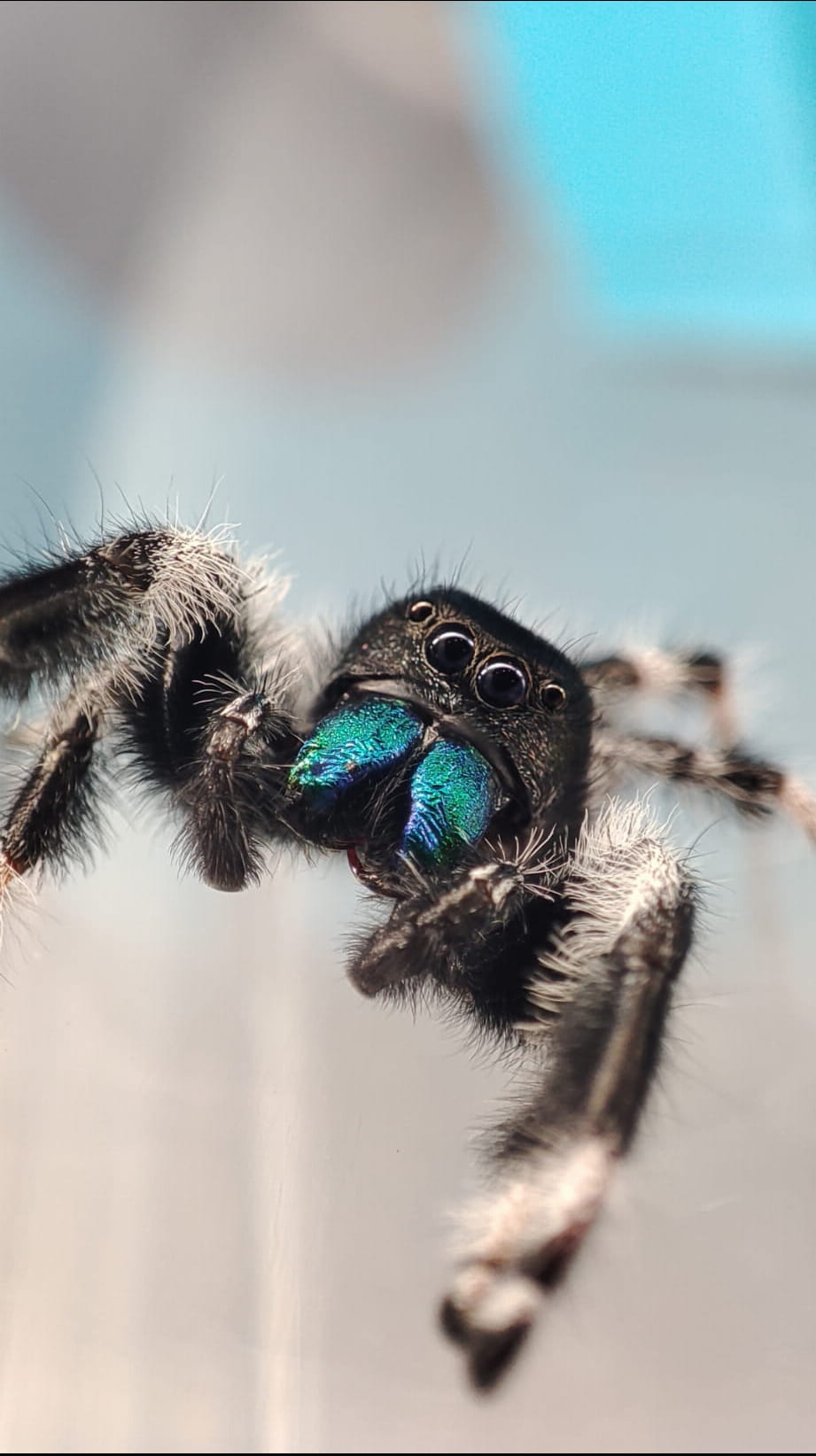
A small spider that looks you directly in the eyes — and knows you're looking back. Phidippus regius belongs to the family Salticidae, the jumping spiders, and operates by an entirely different logic to tarantulas. It doesn't hunt from ambush. It hunts by sight. The Florida form gives you females of 18–22 mm body length, while the males run smaller but far more arresting: a black prosoma, white banding along the walking legs, and iridescent chelicerae that catch the light from across a room. The four front-facing eyes are working instruments — the two large principal eyes resolve shape and movement at several centimetres. Bring your hand toward the enclosure and Phidippus regius lifts its prosoma and tracks you. Not the panic of a startled insect, but a predator reading the situation.
This is a performance in miniature, and the behaviour that defines it is the hunt itself. Rather than spinning a capture web, Phidippus regius patrols actively and launches onto prey at distances up to twenty times its own body length — and before every leap it anchors a silk dragline to the substrate, a safety line that turns each strike into a calculated commitment rather than a gamble. In the evenings you may catch it tapping its pedipalps against the glass, checking whether you've noticed that it already noticed you. Males run through elaborate courtship displays: pedipalps held high, drumming rhythmically, the opisthosoma swaying to present the full vocabulary of colour and motion. The curiosity persists outside any breeding season — some individuals emerge from the hide the moment prey is introduced, drawn less by hunger than by the event itself. A threat posture is rare, and the bite, should it ever happen, is no more than a mild pinch.
Phidippus regius wants height more than floor space. An enclosure of roughly 15 × 15 × 20 cm suits an adult comfortably, with a shelter positioned high up: a piece of cork bark, a cork tube, or foliage anchored near the top. Lay down two to three centimetres of lightly moist coconut fibre and run plants through the full height of the enclosure to give the spider the vertical geometry it stalks across. Room temperature of 22–26°C is plenty. A light mist on one wall is all the watering it needs — it will find the droplets itself. Feed with appropriately sized prey.
Phidippus regius Florida is for the keeper ready to step sideways into a completely different corner of the arachnid world: diurnal, sharp-eyed, openly curious about everything around it — and starting from the most recognised locality of the species. It's a natural entry point for anyone new to jumping spiders and an honest choice for the collector who wants the original reference point on the shelf. One thing is worth saying plainly: jumping spiders live shorter lives than tarantulas. A female reaches 2.5–3 years, a male 1.5–2. This isn't a decade-long relationship. It's a few years of something rarer — a spider that watches the room, watches you, and seems, in its own way, to be paying attention.