






 Choose language
Currency
Choose language
Currency

€32.00
Regular price:
€40.00

€42.50
Regular price:
€50.00
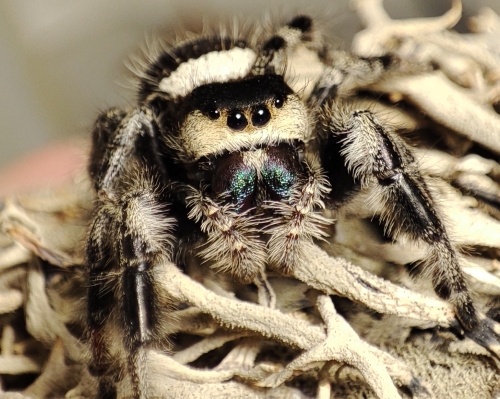


Phidippus regius Apalachicola
product unavailable
Description
A small spider that looks you straight in the eye. And knows you are looking. Phidippus regius belongs to the family Salticidae — the jumping spiders — and to an entirely different order of things than tarantulas. It hunts not by ambush but by sight. The Apalachicola form comes from north-western Florida, from the region of the river of the same name. Females reach 18–22 mm in body length; males are slightly smaller but far more contrasting in colour: a black cephalothorax, white striping on the legs, and intensely iridescent chelicerae visible from a distance. In this species the four front eyes are a living working tool — the two central ones are huge, letting it recognise movement and shape from a dozen centimetres away. Bring a hand near the terrarium and Phidippus regius lifts its head and follows you with its gaze. Not like a fleeing insect, but like a predator sizing up the situation.
This jumping spider is a spectacle in miniature. Instead of building a snare web it actively patrols its territory by day and hunts in leaps twenty times its own body length. Before a strike it freezes, measuring its prey by eye and fixing a safety line to the ground — every jump insured by that silken dragline. In the evening you will see it tap its pedipalps against the glass, waiting for you to notice that it has already noticed you. Males perform their famous courtship dances: raising the pedipalps high, drumming them rhythmically on the ground and swaying the abdomen, presenting the female with a full repertoire of colour and movement. The spider stays curious and active even outside the breeding season — some individuals come out onto the glass the moment food is brought in. It is not aggressive, rarely takes a defensive posture, and its bite is likened to a gentle pinch.
Phidippus regius needs a terrarium that is tall rather than wide — 15×15×20 cm is ample for an adult, with somewhere to shelter in the upper part (a piece of cork bark, a cork tube or leafy décor near the top). The substrate is 2–3 cm of moderately moist coconut fiber; leafy décor throughout the enclosure makes it easier to lie in wait and to hunt. Room temperature of 22–26°C is entirely sufficient. Regular misting — a spritz on the terrarium wall is enough; the spider will come to the droplets itself. Feeding: small insects — Drosophila hydei fruit flies, smaller crickets, or young roaches.
Phidippus regius Apalachicola is a form for the keeper who wants to discover an entirely different world of arachnids — active, diurnal, hunting by sight — and reaches for a specific locality. A good choice too for the collector who already keeps the popular Phidippus forms and is looking for one whose place-name means something only to the initiated. Remember one thing: jumping spiders live shorter lives than tarantulas. A female Phidippus regius lives 2.5–3 years, a male 1.5–2. This is no investment for decades, but a few years of spectacle — intense, visual and mutual.