






 Choose language
- Spiders
- ANIMALS
- Arachnids (Arachnida)
- Spiders (Araneae)
- Tarantulas (Mygalomorphae)
- Psednocnemis spp.
- Diplura spp.
- Spinosatibiapalpus spp.
- Acanthogonatus spp.
- Acanthoscurria spp.
- Amazonius spp.
- Ami spp.
- Anquasha spp.
- Aphonopelma spp.
- Aspinochilus spp.
- Augacephalus spp.
- Avicularia spp.
- Birupes spp.
- Bonnetina spp.
- Brachypelma spp.
- Bumba spp.
- Caribena spp.
- Ceratogyrus spp.
- Chaetopelma spp.
- Chilobrachys spp.
- Chromatopelma spp.
- Cilantica spp.
- Citharacanthus spp.
- Coremiocnemis spp.
- Cyclosternum spp.
- Cyriocosmus spp.
- Cyriopagopus spp.
- Davus spp.
- Dolichothele spp.
- Encyocratella spp.
- Ephebopus spp.
- Euathlus spp.
- Eucratoscelus spp.
- Eupalaestrus spp.
- Fufius spp.
- Gorgyrella spp.
- Grammostola spp.
- Guyruita spp.
- Hapalopus spp.
- Haploclastus spp.
- Haplocosmia spp.
- Haplopelma spp.
- Harpactira spp.
- Heteroscodra spp.
- Heterothele spp.
- Holothele spp.
- Homoeomma spp.
- Hysterocrates spp.
- Idiothele spp.
- Iridopelma spp.
- Kochiana spp.
- Lampropelma spp.
- Lasiocyano spp.
- Lasiodora spp.
- Lasiodorides spp.
- Linothele spp.
- Lyrognathus spp.
- Megaphobema spp.
- Monocentropus spp.
- Neischnocolus spp.
- Neoholothele spp.
- Neostenotarsus spp.
- Nhandu spp.
- Omothymus spp.
- Ornithoctoninae spp.
- Ornithoctonus spp.
- Pamphobeteus spp.
- Pelinobius spp.
- Phormictopus spp.
- Phormingochilus spp.
- Phrixotrichus spp.
- Poecilotheria spp.
- Psalmopoeus spp.
- Pseudhapalopus spp.
- Pseudoclamoris spp.
- Pterinochilus spp.
- Selenocosmia spp.
- Sericopelma spp.
- Tapinauchenius spp.
- Taksinus spp.
- Tapinauchenius spp.
- Theraphosa spp.
- Theraphosidae spp.
- Theraphosinae spp.
- Thrigmopoeus spp.
- Thrixopelma spp.
- Tliltocatl spp.
- Typhochlaena spp.
- Urupelma spp.
- Vitalius spp.
- Xenesthis spp.
- Ybyrapora spp.
- True Spiders (Araneomorphae)
- Velvet Spiders (Eresidae)
- Macrothele spp.
- Liphistius spp.
- Tarantulas (Mygalomorphae)
- Scorpions (Scorpiones)
- Spiders (Araneae)
- Insects - for feeding
- Arachnids (Arachnida)
- Scorpions
- Accessories
- Books
- Centipede
- Millipede
- Cockroaches
- New products
- Products on sale
Currency

€42.50
Regular price:
€50.00

€32.00
Regular price:
€40.00
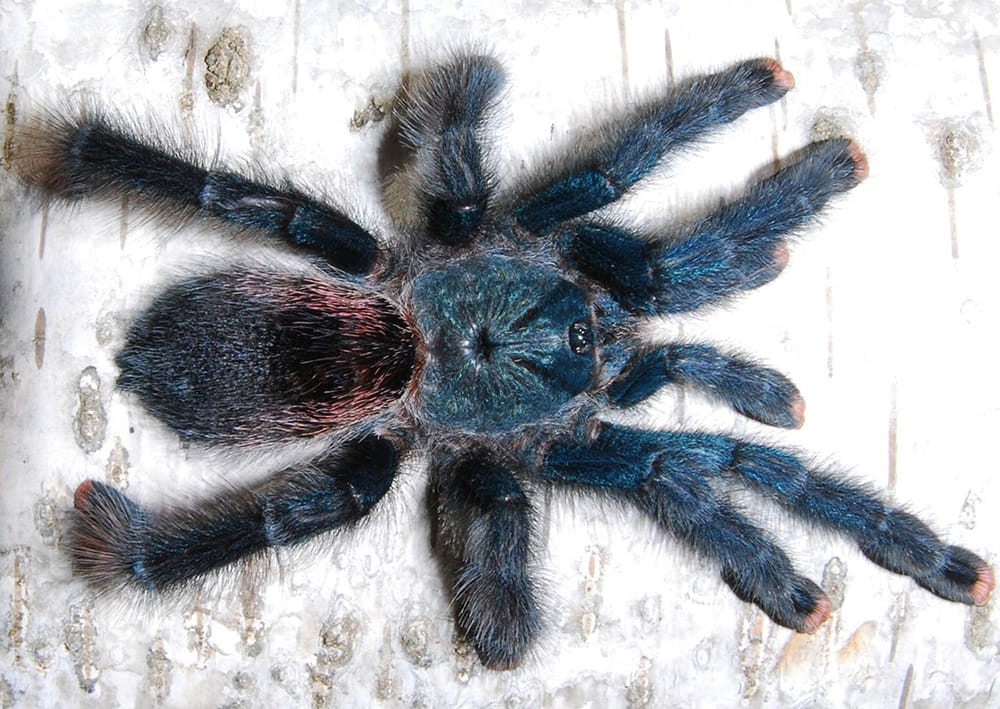
Species: Avicularia avicularia
Common name: Pink-toed tarantula
Native range: South America (Guyana, Suriname, Venezuela, northern Brazil, Trinidad)
Temperature: 24–28°C, with a 2–3°C drop at night; room temperature is generally sufficient
Humidity: 65–70%
Adult size: Females reach up to 6 cm body length
Lifestyle: Arboreal
Speed: Moderate
Venom potency: Mild
Temperament: Calm, but easily startled
Recommended for: Keepers with prior experience of terrestrial species — an ideal first arboreal
Notes: Not CITES-listed; no captive-bred documentation required.
Avicularia avicularia
product unavailable
Description
Few arboreal tarantulas have shaped the hobby quite like Avicularia avicularia. Watch one in the right light and the illusion of a plain black spider falls away — a metallic violet-blue sheen surfaces beneath the dark setae, and each walking leg ends in a warm pink blush. This is the species that introduced generations of European keepers to arboreal husbandry, and it has held that position not by being loud, but by rewarding anyone willing to look closely. In the layered, humid forests of Guyana, Suriname, and Venezuela it spends its life among branches, epiphytes, and tangled aerial roots — and it brings that vertical, three-dimensional life with it into the enclosure.
What sets Avicularia avicularia apart from most arboreal species is its temperament. It is not prone to threat displays, though it does startle easily — an unexpected disturbance typically triggers a fast reflexive leap or a quick retreat into the silken tube retreat. Watching it hunt is one of the genuine pleasures of keeping this species: a controlled strike from cover, silk trailing behind it, followed by a return to the same favoured perch high on whatever structure it has claimed. That consistency of habit is what makes it so rewarding to observe over months and years — you come to know an individual spider, not just a species.
The enclosure should be oriented vertically and built around one priority: airflow. Stagnant air is the leading cause of decline in this species, and no other element of husbandry comes close in importance. A vertical cork tube or upright slab of cork bark serves as the retreat; artificial foliage provides anchor points for webbing. A water dish on the floor, a thin layer of substrate kept lightly damp on one side, and gentle misting of the enclosure walls — never to the point of pooling — complete the setup. Room temperature suits it well.
Avicularia avicularia is the natural first arboreal for a keeper who has spent time with terrestrial species and is ready to move upward — literally. It asks little in the way of specialised conditions, yet it gives back colour, movement, and the particular satisfaction of watching a spider build and inhabit a three-dimensional silk world over years. Keepers who started here rarely part with theirs; the spider tends to settle into the upper corner of its enclosure and stay there, quietly metallic, long after the rest of the collection has turned over.