






 Choose language
- Spiders
- ANIMALS
- Arachnids (Arachnida)
- Spiders (Araneae)
- Tarantulas (Mygalomorphae)
- Psednocnemis spp.
- Diplura spp.
- Spinosatibiapalpus spp.
- Acanthogonatus spp.
- Acanthoscurria spp.
- Amazonius spp.
- Ami spp.
- Anquasha spp.
- Aphonopelma spp.
- Aspinochilus spp.
- Augacephalus spp.
- Avicularia spp.
- Birupes spp.
- Bonnetina spp.
- Brachypelma spp.
- Bumba spp.
- Caribena spp.
- Ceratogyrus spp.
- Chaetopelma spp.
- Chilobrachys spp.
- Chromatopelma spp.
- Cilantica spp.
- Citharacanthus spp.
- Coremiocnemis spp.
- Cyclosternum spp.
- Cyriocosmus spp.
- Cyriopagopus spp.
- Davus spp.
- Dolichothele spp.
- Encyocratella spp.
- Ephebopus spp.
- Euathlus spp.
- Eucratoscelus spp.
- Eupalaestrus spp.
- Fufius spp.
- Gorgyrella spp.
- Grammostola spp.
- Guyruita spp.
- Hapalopus spp.
- Haploclastus spp.
- Haplocosmia spp.
- Haplopelma spp.
- Harpactira spp.
- Heteroscodra spp.
- Heterothele spp.
- Holothele spp.
- Homoeomma spp.
- Hysterocrates spp.
- Idiothele spp.
- Iridopelma spp.
- Kochiana spp.
- Lampropelma spp.
- Lasiocyano spp.
- Lasiodora spp.
- Lasiodorides spp.
- Linothele spp.
- Lyrognathus spp.
- Megaphobema spp.
- Monocentropus spp.
- Neischnocolus spp.
- Neoholothele spp.
- Neostenotarsus spp.
- Nhandu spp.
- Omothymus spp.
- Ornithoctoninae spp.
- Ornithoctonus spp.
- Pamphobeteus spp.
- Pelinobius spp.
- Phormictopus spp.
- Phormingochilus spp.
- Phrixotrichus spp.
- Poecilotheria spp.
- Psalmopoeus spp.
- Pseudhapalopus spp.
- Pseudoclamoris spp.
- Pterinochilus spp.
- Selenocosmia spp.
- Sericopelma spp.
- Tapinauchenius spp.
- Taksinus spp.
- Tapinauchenius spp.
- Theraphosa spp.
- Theraphosidae spp.
- Theraphosinae spp.
- Thrigmopoeus spp.
- Thrixopelma spp.
- Tliltocatl spp.
- Typhochlaena spp.
- Urupelma spp.
- Vitalius spp.
- Xenesthis spp.
- Ybyrapora spp.
- True Spiders (Araneomorphae)
- Velvet Spiders (Eresidae)
- Macrothele spp.
- Liphistius spp.
- Tarantulas (Mygalomorphae)
- Scorpions (Scorpiones)
- Spiders (Araneae)
- Insects - for feeding
- Arachnids (Arachnida)
- Scorpions
- Accessories
- Books
- Centipede
- Millipede
- Cockroaches
- New products
- Products on sale
Currency

€42.50
Regular price:
€50.00

€32.00
Regular price:
€40.00
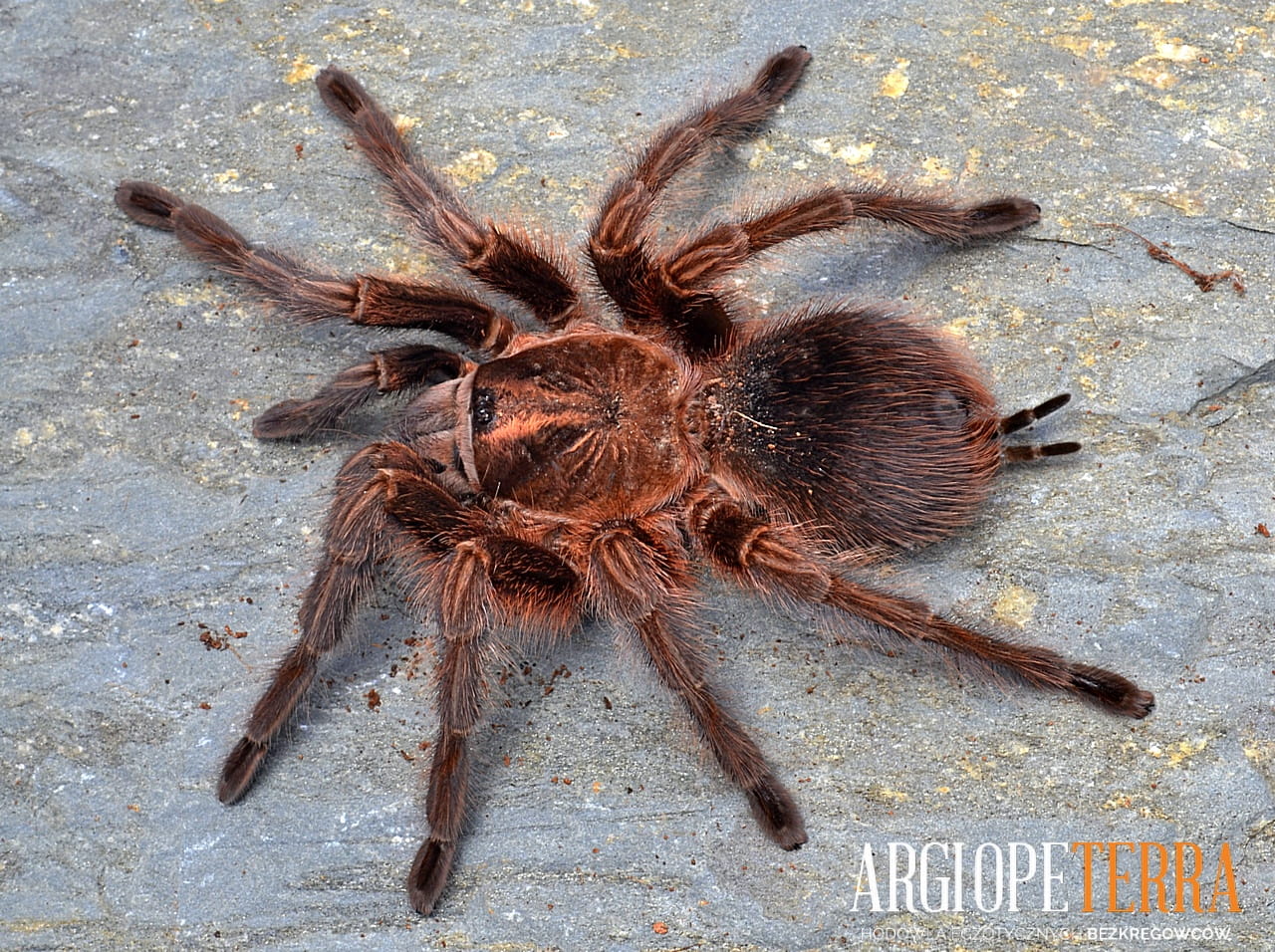
Species: Phormictopus auratus
Common name: -
Native range: Hispaniola (Haiti, Dominican Republic)
Temperature: 25–28 °C
Humidity: 70–80%
Adult size: 7 cm BL
Lifestyle: terrestrial
Speed: fast
Venom potency: mild
Temperament: defensive when disturbed
Recommended for: experienced keepers
Notes: This species does not require CITES documentation.
Phormictopus auratus
product unavailable
Description
Phormictopus auratus hails from Hispaniola, the humid tropical forests shared between Haiti and the Dominican Republic. It is a large, heavy-bodied Caribbean tarantula — dark at first glance, yet warmed throughout by a burnished glow that shifts under direct light. The species name *auratus* means "golden," and the animal earns it: what looks near-black in shadow reveals itself as something closer to glowing embers when the light catches it at the right angle. Broad across the prosoma and substantial through the opisthosoma, this is a spider that occupies its enclosure with quiet authority.
Like the rest of the genus, Phormictopus auratus is quick, alert, and entirely disinclined to be handled casually. It is terrestrial, moves with purpose, and carries a defensive streak that leaves no room for complacency. Working in the keeper's favour is a powerful feeding response and a growth rate that rewards attentive husbandry with visible progress from one moult to the next.
In the enclosure, 7–10 cm of coconut fibre substrate forms the base, paired with a cork hide and a generously sized water dish. Humidity should sit at moderate to slightly higher levels, maintained through regular misting with good cross-ventilation to keep the air moving. Room temperature suits the species well — no supplemental heating is required under typical household conditions. Appropriately sized prey is taken with enthusiasm and is rarely refused.
Phormictopus auratus is for the keeper who already understands what the genus asks of them and wants it in its most visually arresting form. The golden shimmer is the signature here — the detail that stops experienced collectors mid-scroll and lingers on want lists for years. For those who take Caribbean tarantulas seriously, this is the kind of animal that quietly works its way to the centre of the collection and stays there.