






 Choose language
- Spiders
- ANIMALS
- Arachnids (Arachnida)
- Spiders (Araneae)
- Tarantulas (Mygalomorphae)
- Psednocnemis spp.
- Diplura spp.
- Spinosatibiapalpus spp.
- Acanthogonatus spp.
- Acanthoscurria spp.
- Amazonius spp.
- Ami spp.
- Anquasha spp.
- Aphonopelma spp.
- Aspinochilus spp.
- Augacephalus spp.
- Avicularia spp.
- Birupes spp.
- Bonnetina spp.
- Brachypelma spp.
- Bumba spp.
- Caribena spp.
- Ceratogyrus spp.
- Chaetopelma spp.
- Chilobrachys spp.
- Chromatopelma spp.
- Cilantica spp.
- Citharacanthus spp.
- Coremiocnemis spp.
- Cyclosternum spp.
- Cyriocosmus spp.
- Cyriopagopus spp.
- Davus spp.
- Dolichothele spp.
- Encyocratella spp.
- Ephebopus spp.
- Euathlus spp.
- Eucratoscelus spp.
- Eupalaestrus spp.
- Fufius spp.
- Gorgyrella spp.
- Grammostola spp.
- Guyruita spp.
- Hapalopus spp.
- Haploclastus spp.
- Haplocosmia spp.
- Haplopelma spp.
- Harpactira spp.
- Heteroscodra spp.
- Heterothele spp.
- Holothele spp.
- Homoeomma spp.
- Hysterocrates spp.
- Idiothele spp.
- Iridopelma spp.
- Kochiana spp.
- Lampropelma spp.
- Lasiocyano spp.
- Lasiodora spp.
- Lasiodorides spp.
- Linothele spp.
- Lyrognathus spp.
- Megaphobema spp.
- Monocentropus spp.
- Neischnocolus spp.
- Neoholothele spp.
- Neostenotarsus spp.
- Nhandu spp.
- Omothymus spp.
- Ornithoctoninae spp.
- Ornithoctonus spp.
- Pamphobeteus spp.
- Pelinobius spp.
- Phormictopus spp.
- Phormingochilus spp.
- Phrixotrichus spp.
- Poecilotheria spp.
- Psalmopoeus spp.
- Pseudhapalopus spp.
- Pseudoclamoris spp.
- Pterinochilus spp.
- Selenocosmia spp.
- Sericopelma spp.
- Tapinauchenius spp.
- Taksinus spp.
- Tapinauchenius spp.
- Theraphosa spp.
- Theraphosidae spp.
- Theraphosinae spp.
- Thrigmopoeus spp.
- Thrixopelma spp.
- Tliltocatl spp.
- Typhochlaena spp.
- Urupelma spp.
- Vitalius spp.
- Xenesthis spp.
- Ybyrapora spp.
- True Spiders (Araneomorphae)
- Velvet Spiders (Eresidae)
- Macrothele spp.
- Liphistius spp.
- Tarantulas (Mygalomorphae)
- Scorpions (Scorpiones)
- Spiders (Araneae)
- Insects - for feeding
- Arachnids (Arachnida)
- Scorpions
- Accessories
- Books
- Centipede
- Millipede
- Cockroaches
- New products
- Products on sale
Currency

€32.00
Regular price:
€40.00

€42.50
Regular price:
€50.00


Species: Pamphobeteus sp. machala
Common name: -
Native range: Ecuador (Pacific lowlands near Machala)
Temperature: 24–26°C
Humidity: 75–80%
Adult size: 7–9 cm body length, up to ~20 cm leg span
Lifestyle: terrestrial, burrowing
Speed: moderate
Venom potency: mild to moderate
Temperament: placid as juveniles, more defensive as adults; readily kicks urticating setae
Recommended for: intermediate keepers
Notes: Not CITES-listed; no captive-bred documentation required.
Pamphobeteus sp. machala
product unavailable
Description
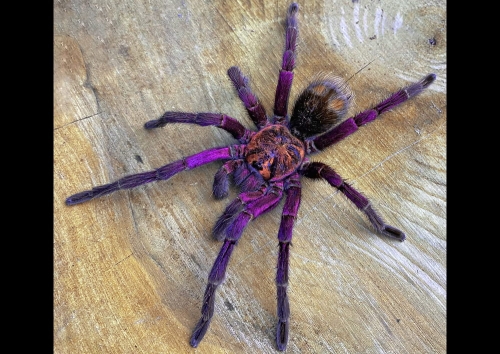
Pamphobeteus sp. machala comes from the lowland Pacific coast of Ecuador, near the city of Machala — humid tropical forest that packs more living biomass into a square metre than most keepers will ever see in person. It belongs to a genus that owns the word "massive" more completely than almost any other in Theraphosidae, and even as a formally undescribed species it carries the family hallmarks in full. Adult females reach 7–9 cm in body length with a leg span approaching 20 cm. Mature males are smaller but easily among the most visually arresting animals the hobby produces — deep violets, midnight blues and metallic rose washed across the legs and carapace in a combination that looks less like camouflage and more like deliberate design.
Juveniles are placid enough to earn a reputation for tolerance, but adult females develop a personality that makes itself known. At feeding time they are decisive; when disturbed, they are direct, willing to kick urticating setae with the practised ease of a New World species that has never needed to be otherwise. Venom is mild to moderate and poses no serious concern to a healthy adult. Pamphobeteus sp. machala is terrestrial with a strong inclination to excavate shallow burrows and claim cover beneath cork bark or other furniture. Ambush hunting from the burrow entrance is the defining behaviour to watch for — an adult female poised at the threshold of her hide, motionless until the instant she isn't, is the kind of tableau that earns a prime spot in any collection.
The enclosure should be roomy: a footprint of at least 30×30 cm for adult females, with a 7–10 cm layer of coconut fibre mixed with topsoil. A cork tube or slab provides the anchor point around which she will organise her territory. Keep most of the substrate dry and dampen one corner regularly to maintain a moist zone. Adults appreciate a water dish; with juveniles, light misting of the enclosure walls is enough. Room temperature suits the species well. Feed appropriately sized prey at whatever interval keeps the animal in good condition.
Pamphobeteus sp. machala is a natural graduation purchase for the intermediate keeper ready to move into large-bodied Pamphobeteus — the genus where scale stops being a number and starts being a presence. It is hardy, straightforward to maintain and asks nothing exotic of its keeper beyond adequate space and a certain patient respect for an animal that has developed opinions. Give it both, and a decade from now you will still find yourself pausing at the enclosure for the slow, deliberate weight of every feeding strike and every post-moult emergence — the kind of presence smaller spiders simply cannot offer.