






 Choose language
- Spiders
- ANIMALS
- Arachnids (Arachnida)
- Spiders (Araneae)
- Tarantulas (Mygalomorphae)
- Psednocnemis spp.
- Diplura spp.
- Spinosatibiapalpus spp.
- Acanthogonatus spp.
- Acanthoscurria spp.
- Amazonius spp.
- Ami spp.
- Anquasha spp.
- Aphonopelma spp.
- Aspinochilus spp.
- Augacephalus spp.
- Avicularia spp.
- Birupes spp.
- Bonnetina spp.
- Brachypelma spp.
- Bumba spp.
- Caribena spp.
- Ceratogyrus spp.
- Chaetopelma spp.
- Chilobrachys spp.
- Chromatopelma spp.
- Cilantica spp.
- Citharacanthus spp.
- Coremiocnemis spp.
- Cyclosternum spp.
- Cyriocosmus spp.
- Cyriopagopus spp.
- Davus spp.
- Dolichothele spp.
- Encyocratella spp.
- Ephebopus spp.
- Euathlus spp.
- Eucratoscelus spp.
- Eupalaestrus spp.
- Fufius spp.
- Gorgyrella spp.
- Grammostola spp.
- Guyruita spp.
- Hapalopus spp.
- Haploclastus spp.
- Haplocosmia spp.
- Haplopelma spp.
- Harpactira spp.
- Heteroscodra spp.
- Heterothele spp.
- Holothele spp.
- Homoeomma spp.
- Hysterocrates spp.
- Idiothele spp.
- Iridopelma spp.
- Kochiana spp.
- Lampropelma spp.
- Lasiocyano spp.
- Lasiodora spp.
- Lasiodorides spp.
- Linothele spp.
- Lyrognathus spp.
- Megaphobema spp.
- Monocentropus spp.
- Neischnocolus spp.
- Neoholothele spp.
- Neostenotarsus spp.
- Nhandu spp.
- Omothymus spp.
- Ornithoctoninae spp.
- Ornithoctonus spp.
- Pamphobeteus spp.
- Pelinobius spp.
- Phormictopus spp.
- Phormingochilus spp.
- Phrixotrichus spp.
- Poecilotheria spp.
- Psalmopoeus spp.
- Pseudhapalopus spp.
- Pseudoclamoris spp.
- Pterinochilus spp.
- Selenocosmia spp.
- Sericopelma spp.
- Tapinauchenius spp.
- Taksinus spp.
- Tapinauchenius spp.
- Theraphosa spp.
- Theraphosidae spp.
- Theraphosinae spp.
- Thrigmopoeus spp.
- Thrixopelma spp.
- Tliltocatl spp.
- Typhochlaena spp.
- Urupelma spp.
- Vitalius spp.
- Xenesthis spp.
- Ybyrapora spp.
- True Spiders (Araneomorphae)
- Velvet Spiders (Eresidae)
- Macrothele spp.
- Liphistius spp.
- Tarantulas (Mygalomorphae)
- Scorpions (Scorpiones)
- Spiders (Araneae)
- Insects - for feeding
- Arachnids (Arachnida)
- Scorpions
- Accessories
- Books
- Centipede
- Millipede
- Cockroaches
- New products
- Products on sale
Currency

€32.00
Regular price:
€40.00

€42.50
Regular price:
€50.00
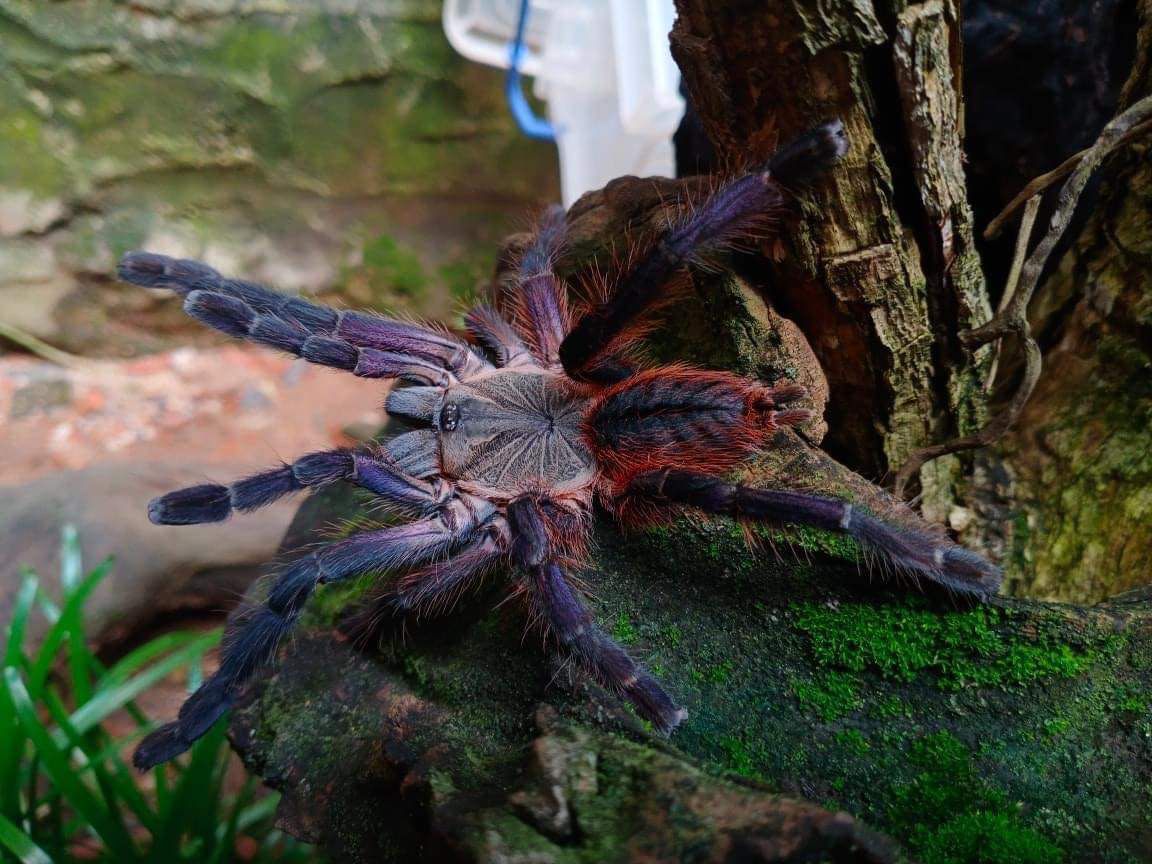
Species: Ornithoctoninae sp. Phan Cay RED
Common name: -
Native range: Vietnam (Phan Cay region)
Temperature: 24–28°C
Humidity: 70–80%
Adult size: 5 cm BL
Lifestyle: Fossorial
Speed: Fast
Venom potency: Potent
Temperament: Defensive
Recommended for: Advanced keepers
Notes: Not CITES listed; no captive-bred documentation required.
Ornithoctoninae sp. Phan Cay RED
product unavailable
Description
Ornithoctoninae sp. Phan Cay RED hails from Vietnam's Phan Cay region, and even among the earth tigers — a group not known for half-measures — it stops you in your tracks. The carapace and abdomen run dark, almost sooty, while the legs carry a warm rufous-brown that reads like cooling iron in low light. That is what sets the RED form apart from its blue-toned counterpart sharing the same locality: where the blue variant runs cool and metallic, the RED smoulders. The build is heavy and deliberate, the sort of frame that looks settled into itself even at perfect rest.
Stillness, however, is not what this spider is known for. Ornithoctoninae sp. Phan Cay RED is fast, decisive, and wholly committed to defending its ground. It excavates deep burrows and treats them as territory worth holding — intrusion is answered with speed rather than posturing. The appetite is strong and consistent, and growth reflects it. Every movement carries weight.
A fossorial spider of this size needs substrate to match its ambitions: at least 10 cm of moist coconut fibre mixed with loam, packed firmly enough to hold a burrow's architecture. Keep a water dish topped up at all times. Regular misting keeps the deeper substrate damp without waterlogging the surface. Temperatures of 24–28°C suit this species; in cooler climates room temperature rarely cuts it, so warmth should be verified rather than assumed.
This is a spider for keepers who already know the rhythms of Asian earth tigers and want something that pushes that relationship further. The RED locality form turns up rarely enough that it almost never lands in a collection by accident — those who acquire one have usually been hunting it for a while, and a season spent watching it patrol the mouth of a well-built burrow tends to settle the matter for good.