






 Choose language
- Spiders
- ANIMALS
- Arachnids (Arachnida)
- Spiders (Araneae)
- Tarantulas (Mygalomorphae)
- Psednocnemis spp.
- Diplura spp.
- Spinosatibiapalpus spp.
- Acanthogonatus spp.
- Acanthoscurria spp.
- Amazonius spp.
- Ami spp.
- Anquasha spp.
- Aphonopelma spp.
- Aspinochilus spp.
- Augacephalus spp.
- Avicularia spp.
- Birupes spp.
- Bonnetina spp.
- Brachypelma spp.
- Bumba spp.
- Caribena spp.
- Ceratogyrus spp.
- Chaetopelma spp.
- Chilobrachys spp.
- Chromatopelma spp.
- Cilantica spp.
- Citharacanthus spp.
- Coremiocnemis spp.
- Cyclosternum spp.
- Cyriocosmus spp.
- Cyriopagopus spp.
- Davus spp.
- Dolichothele spp.
- Encyocratella spp.
- Ephebopus spp.
- Euathlus spp.
- Eucratoscelus spp.
- Eupalaestrus spp.
- Fufius spp.
- Gorgyrella spp.
- Grammostola spp.
- Guyruita spp.
- Hapalopus spp.
- Haploclastus spp.
- Haplocosmia spp.
- Haplopelma spp.
- Harpactira spp.
- Heteroscodra spp.
- Heterothele spp.
- Holothele spp.
- Homoeomma spp.
- Hysterocrates spp.
- Idiothele spp.
- Iridopelma spp.
- Kochiana spp.
- Lampropelma spp.
- Lasiocyano spp.
- Lasiodora spp.
- Lasiodorides spp.
- Linothele spp.
- Lyrognathus spp.
- Megaphobema spp.
- Monocentropus spp.
- Neischnocolus spp.
- Neoholothele spp.
- Neostenotarsus spp.
- Nhandu spp.
- Omothymus spp.
- Ornithoctoninae spp.
- Ornithoctonus spp.
- Pamphobeteus spp.
- Pelinobius spp.
- Phormictopus spp.
- Phormingochilus spp.
- Phrixotrichus spp.
- Poecilotheria spp.
- Psalmopoeus spp.
- Pseudhapalopus spp.
- Pseudoclamoris spp.
- Pterinochilus spp.
- Selenocosmia spp.
- Sericopelma spp.
- Tapinauchenius spp.
- Taksinus spp.
- Tapinauchenius spp.
- Theraphosa spp.
- Theraphosidae spp.
- Theraphosinae spp.
- Thrigmopoeus spp.
- Thrixopelma spp.
- Tliltocatl spp.
- Typhochlaena spp.
- Urupelma spp.
- Vitalius spp.
- Xenesthis spp.
- Ybyrapora spp.
- True Spiders (Araneomorphae)
- Velvet Spiders (Eresidae)
- Macrothele spp.
- Liphistius spp.
- Tarantulas (Mygalomorphae)
- Scorpions (Scorpiones)
- Spiders (Araneae)
- Insects - for feeding
- Arachnids (Arachnida)
- Scorpions
- Accessories
- Books
- Centipede
- Millipede
- Cockroaches
- New products
- Products on sale
Currency

€32.00
Regular price:
€40.00

€42.50
Regular price:
€50.00
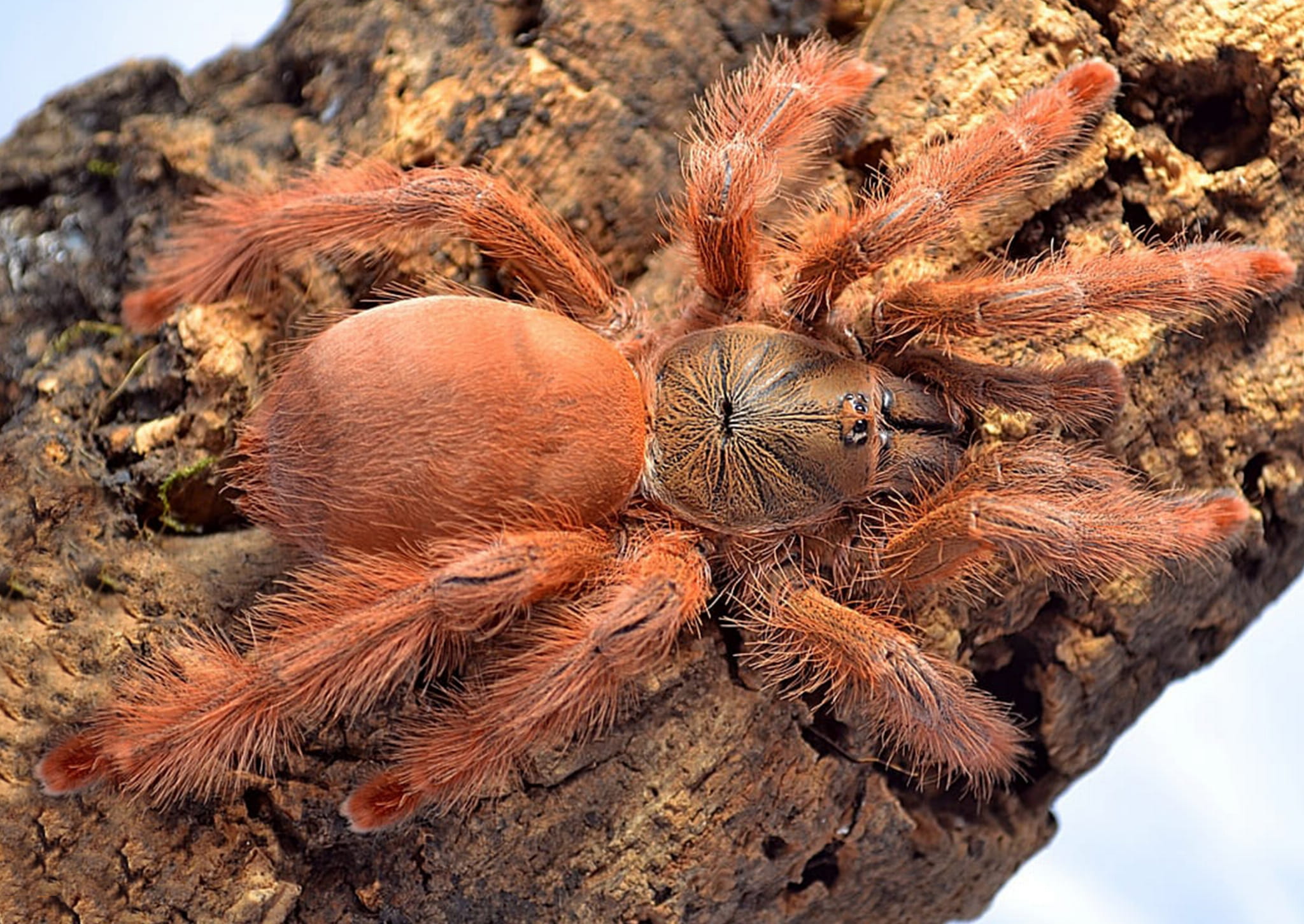
Species: Amazonius germani (ex. Tapinauchenius gigas)
Common name: Orange Tree Spider
Native range: French Guiana, Brazil
Temperature: 24–28°C with a 2–3°C drop at night
Humidity: 70–80%
Adult size: Female approx. 6 cm body length (13–15 cm leg span); male approx. 3–3.5 cm body length
Lifestyle: Arboreal
Speed: Very fast
Venom potency: Mild to moderate — bite reported as painful
Temperament: Skittish; defensive when pressed
Recommended for: Advanced keepers
Notes: Not listed under CITES; no captive-bred certificate required.
Amazonius germani
product unavailable
Description
Few arboreals make you reconsider what "orange" can mean until you've watched Amazonius germani catch the light. Across the canopies of French Guiana and Brazil, this species — formerly shuffled through Tapinauchenius and Pseudoclamoris before landing in its current genus — burns a deep, saturated orange from carapace to leg tip, the kind of colour that reads like embers caught in amber when the angle is right. The English-speaking hobby calls it the Orange Tree Spider, and for once the common name earns its keep.
In the enclosure, Amazonius germani keeps you honest. It is fast, deliberate, and reads the space around it before you've finished framing the thought. It hunts with conviction, holds its ground when pressed, and can shift from settled to threat posture in the span of a breath. A bite demands genuine respect — which is exactly what this species asks of its keeper. Approach the enclosure expecting a placid arboreal and Amazonius germani will correct the assumption quickly.
Housing should be oriented vertically; height matters far more than floor space. A cork tube or slab of cork bark stood upright provides the anchor from which the spider will build its silken tube retreat, draping silk across any additional climbing décor or artificial foliage you provide. Substrate depth is secondary — Amazonius germani does not burrow and spends little time at ground level — though a water dish on the enclosure floor should always be available. Keep humidity moderate to slightly elevated through regular misting, paired with strong cross-ventilation. Room temperature suits the species in most Central European homes, though the mid-twenties Celsius are equally well tolerated. Feed appropriately sized prey on a consistent schedule.
Amazonius germani rewards the experienced keeper who wants an arboreal that earns its shelf space every single day — not through passive display, but through the compressed intensity of watching a flame-coloured spider do exactly what a fast flame-coloured spider does. Years in, you'll find it has become the enclosure your eye drifts to first, every time you walk past the rack.