






 Choose language
- Spiders
- ANIMALS
- Arachnids (Arachnida)
- Spiders (Araneae)
- Tarantulas (Mygalomorphae)
- Psednocnemis spp.
- Diplura spp.
- Spinosatibiapalpus spp.
- Acanthogonatus spp.
- Acanthoscurria spp.
- Amazonius spp.
- Ami spp.
- Anquasha spp.
- Aphonopelma spp.
- Aspinochilus spp.
- Augacephalus spp.
- Avicularia spp.
- Birupes spp.
- Bonnetina spp.
- Brachypelma spp.
- Bumba spp.
- Caribena spp.
- Ceratogyrus spp.
- Chaetopelma spp.
- Chilobrachys spp.
- Chromatopelma spp.
- Cilantica spp.
- Citharacanthus spp.
- Coremiocnemis spp.
- Cyclosternum spp.
- Cyriocosmus spp.
- Cyriopagopus spp.
- Davus spp.
- Dolichothele spp.
- Encyocratella spp.
- Ephebopus spp.
- Euathlus spp.
- Eucratoscelus spp.
- Eupalaestrus spp.
- Fufius spp.
- Gorgyrella spp.
- Grammostola spp.
- Guyruita spp.
- Hapalopus spp.
- Haploclastus spp.
- Haplocosmia spp.
- Haplopelma spp.
- Harpactira spp.
- Heteroscodra spp.
- Heterothele spp.
- Holothele spp.
- Homoeomma spp.
- Hysterocrates spp.
- Idiothele spp.
- Iridopelma spp.
- Kochiana spp.
- Lampropelma spp.
- Lasiocyano spp.
- Lasiodora spp.
- Lasiodorides spp.
- Linothele spp.
- Lyrognathus spp.
- Megaphobema spp.
- Monocentropus spp.
- Neischnocolus spp.
- Neoholothele spp.
- Neostenotarsus spp.
- Nhandu spp.
- Omothymus spp.
- Ornithoctoninae spp.
- Ornithoctonus spp.
- Pamphobeteus spp.
- Pelinobius spp.
- Phormictopus spp.
- Phormingochilus spp.
- Phrixotrichus spp.
- Poecilotheria spp.
- Psalmopoeus spp.
- Pseudhapalopus spp.
- Pseudoclamoris spp.
- Pterinochilus spp.
- Selenocosmia spp.
- Sericopelma spp.
- Tapinauchenius spp.
- Taksinus spp.
- Tapinauchenius spp.
- Theraphosa spp.
- Theraphosidae spp.
- Theraphosinae spp.
- Thrigmopoeus spp.
- Thrixopelma spp.
- Tliltocatl spp.
- Typhochlaena spp.
- Urupelma spp.
- Vitalius spp.
- Xenesthis spp.
- Ybyrapora spp.
- True Spiders (Araneomorphae)
- Velvet Spiders (Eresidae)
- Macrothele spp.
- Liphistius spp.
- Tarantulas (Mygalomorphae)
- Scorpions (Scorpiones)
- Spiders (Araneae)
- Insects - for feeding
- Arachnids (Arachnida)
- Scorpions
- Accessories
- Books
- Centipede
- Millipede
- Cockroaches
- New products
- Products on sale
Currency

€42.50
Regular price:
€50.00

€32.00
Regular price:
€40.00
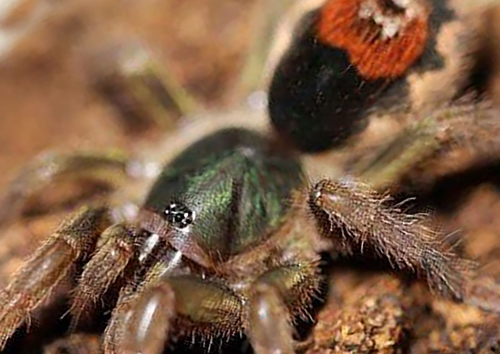


Species: Neostenotarsus sp. 'surinam'
Common name: -
Native range: Suriname
Temperature: 24–27 °C
Humidity: 70–80%
Adult size: 3–4 cm body length
Lifestyle: Terrestrial
Speed: Moderate
Venom potency: Mild
Temperament: Calm
Recommended for: Experienced keepers — rare species
First spider: No
Notes: Dwarf species. Very rarely kept in captivity.
Neostenotarsus sp surinam
product unavailable
Description
From the humid coastal rainforests of Suriname comes a spider almost no one in the hobby has ever kept. Neostenotarsus sp. 'surinam' belongs to a genus so thinly represented in collections, and so sparsely documented in literature, that owning one places you on a very short list of keepers worldwide. It is a small, dark, lightly built tarantula with subtle tonal accents — unassuming in posture, unhurried in movement, and quietly fascinating precisely because so little is known about it.
Behaviourally, Neostenotarsus sp. 'surinam' offers a slow, deliberate kind of company. It is terrestrial, calm, and entirely undramatic — no threat postures to read, no sudden bolts across the substrate, no defensive theatre. The appetite is modest, scaled to the spider's small frame. Watching this species is closer to observing a small, self-contained creature go about its life on its own terms than it is to keeping any of the better-known showpieces.
Housing Neostenotarsus sp. 'surinam' is refreshingly simple. A small, well-ventilated enclosure with around 5 cm of moist coconut fibre substrate, a cork hide, and a shallow water dish covers everything this spider asks for. Humidity should sit in the moderate range, maintained by occasional misting rather than constant saturation. Room temperature is fine. Stability matters far more than intervention here.
Neostenotarsus sp. 'surinam' isn't for the keeper chasing colour or drama — it is for the collector who recognises that scientific rarity is itself a form of value. Years from now, when this genus finally attracts the formal attention it deserves, the handful of keepers who took the time to observe these animals closely will hold something no published paper can offer: firsthand experience with a spider almost nobody else thought to keep.