






 Choose language
- Spiders
- ANIMALS
- Arachnids (Arachnida)
- Spiders (Araneae)
- Tarantulas (Mygalomorphae)
- Psednocnemis spp.
- Diplura spp.
- Spinosatibiapalpus spp.
- Acanthogonatus spp.
- Acanthoscurria spp.
- Amazonius spp.
- Ami spp.
- Anquasha spp.
- Aphonopelma spp.
- Aspinochilus spp.
- Augacephalus spp.
- Avicularia spp.
- Birupes spp.
- Bonnetina spp.
- Brachypelma spp.
- Bumba spp.
- Caribena spp.
- Ceratogyrus spp.
- Chaetopelma spp.
- Chilobrachys spp.
- Chromatopelma spp.
- Cilantica spp.
- Citharacanthus spp.
- Coremiocnemis spp.
- Cyclosternum spp.
- Cyriocosmus spp.
- Cyriopagopus spp.
- Davus spp.
- Dolichothele spp.
- Encyocratella spp.
- Ephebopus spp.
- Euathlus spp.
- Eucratoscelus spp.
- Eupalaestrus spp.
- Fufius spp.
- Gorgyrella spp.
- Grammostola spp.
- Guyruita spp.
- Hapalopus spp.
- Haploclastus spp.
- Haplocosmia spp.
- Haplopelma spp.
- Harpactira spp.
- Heteroscodra spp.
- Heterothele spp.
- Holothele spp.
- Homoeomma spp.
- Hysterocrates spp.
- Idiothele spp.
- Iridopelma spp.
- Kochiana spp.
- Lampropelma spp.
- Lasiocyano spp.
- Lasiodora spp.
- Lasiodorides spp.
- Linothele spp.
- Lyrognathus spp.
- Megaphobema spp.
- Monocentropus spp.
- Neischnocolus spp.
- Neoholothele spp.
- Neostenotarsus spp.
- Nhandu spp.
- Omothymus spp.
- Ornithoctoninae spp.
- Ornithoctonus spp.
- Pamphobeteus spp.
- Pelinobius spp.
- Phormictopus spp.
- Phormingochilus spp.
- Phrixotrichus spp.
- Poecilotheria spp.
- Psalmopoeus spp.
- Pseudhapalopus spp.
- Pseudoclamoris spp.
- Pterinochilus spp.
- Selenocosmia spp.
- Sericopelma spp.
- Tapinauchenius spp.
- Taksinus spp.
- Tapinauchenius spp.
- Theraphosa spp.
- Theraphosidae spp.
- Theraphosinae spp.
- Thrigmopoeus spp.
- Thrixopelma spp.
- Tliltocatl spp.
- Typhochlaena spp.
- Urupelma spp.
- Vitalius spp.
- Xenesthis spp.
- Ybyrapora spp.
- True Spiders (Araneomorphae)
- Velvet Spiders (Eresidae)
- Macrothele spp.
- Liphistius spp.
- Tarantulas (Mygalomorphae)
- Scorpions (Scorpiones)
- Spiders (Araneae)
- Insects - for feeding
- Arachnids (Arachnida)
- Scorpions
- Accessories
- Books
- Centipede
- Millipede
- Cockroaches
- New products
- Products on sale
Currency

€32.00
Regular price:
€40.00

€42.50
Regular price:
€50.00
Species: Tliltocatl schroederi
Common name: Mexican Black Velvet
Native range: Mexico (Oaxaca, Central Valleys)
Temperature: 22-26°C; room temperature suits it well
Humidity: 60-70%
Adult size: Females reach about 5 cm body length, males about 3.5 cm
Lifestyle: Terrestrial
Speed: Slow
Venom potency: Mild
Temperament: Docile; may kick urticating hairs
Recommended for: Beginners and experienced keepers alike
Notes: The genus Tliltocatl is CITES-listed (Appendix II, EU Annex B) - our specimens are captive bred and come with origin documentation
Tliltocatl schroederi
product unavailable
Description
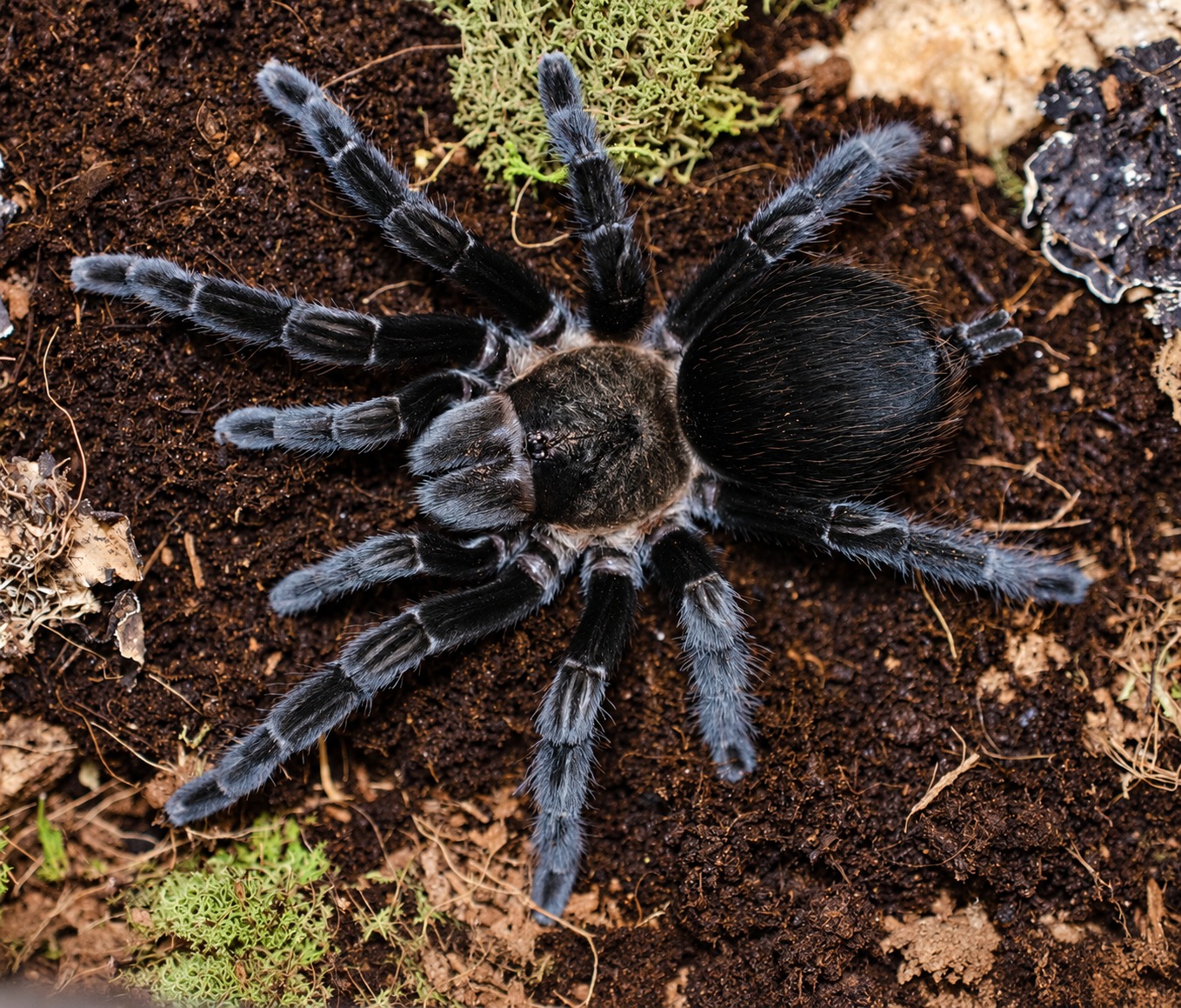
The Central Valleys of Oaxaca in Mexico are a landscape of dry, rocky slopes and sparse vegetation. This is home to Tliltocatl schroederi, described in 2003 as Brachypelma schroederi and placed in Tliltocatl in 2019. Unlike many of its relatives it carries no red hairs on the abdomen. Instead it is dark brown to black with a velvety sheen, which earned it the name Mexican Black Velvet. Understated elegance, at its best just after a moult. The photo shows the contrast well: a velvety black abdomen and femurs, with pale silvery-grey bands on the lower legs.
Like the rest of the genus it is calm and slow-moving. It spends most of its time in or at the mouth of its retreat, happily uses existing hollows and reshapes the substrate to suit itself. When disturbed it usually retreats, and may kick urticating hairs from the abdomen. Growth is slow, so every moult is an event. We offer females and males of around 2-2.5 cm body length: females reach about 5 cm and can live for more than 20 years, while males stay smaller and mature sooner.
A standard terrestrial setup is all it needs: an enclosure wider than it is tall, 5-7 cm of coconut fibre, a cork bark hide and a water dish. Keep most of the substrate dry and mist a small area, for example around the water dish, regularly and lightly, so the spider can choose its own humidity. Room temperature is perfectly adequate. Feed crickets or roaches sized to the spider.
It works equally well as a first tarantula and in the collection of an experienced keeper of Mexican species. Calm, long-lived and quietly beautiful, it is a spider to enjoy watching for many years. The genus Tliltocatl is CITES-listed (Appendix II, EU Annex B). Our specimens are captive bred and come with origin documentation.