





 Choose language
Currency
Choose language
Currency

€42.50
Regular price:
€50.00

€32.00
Regular price:
€40.00
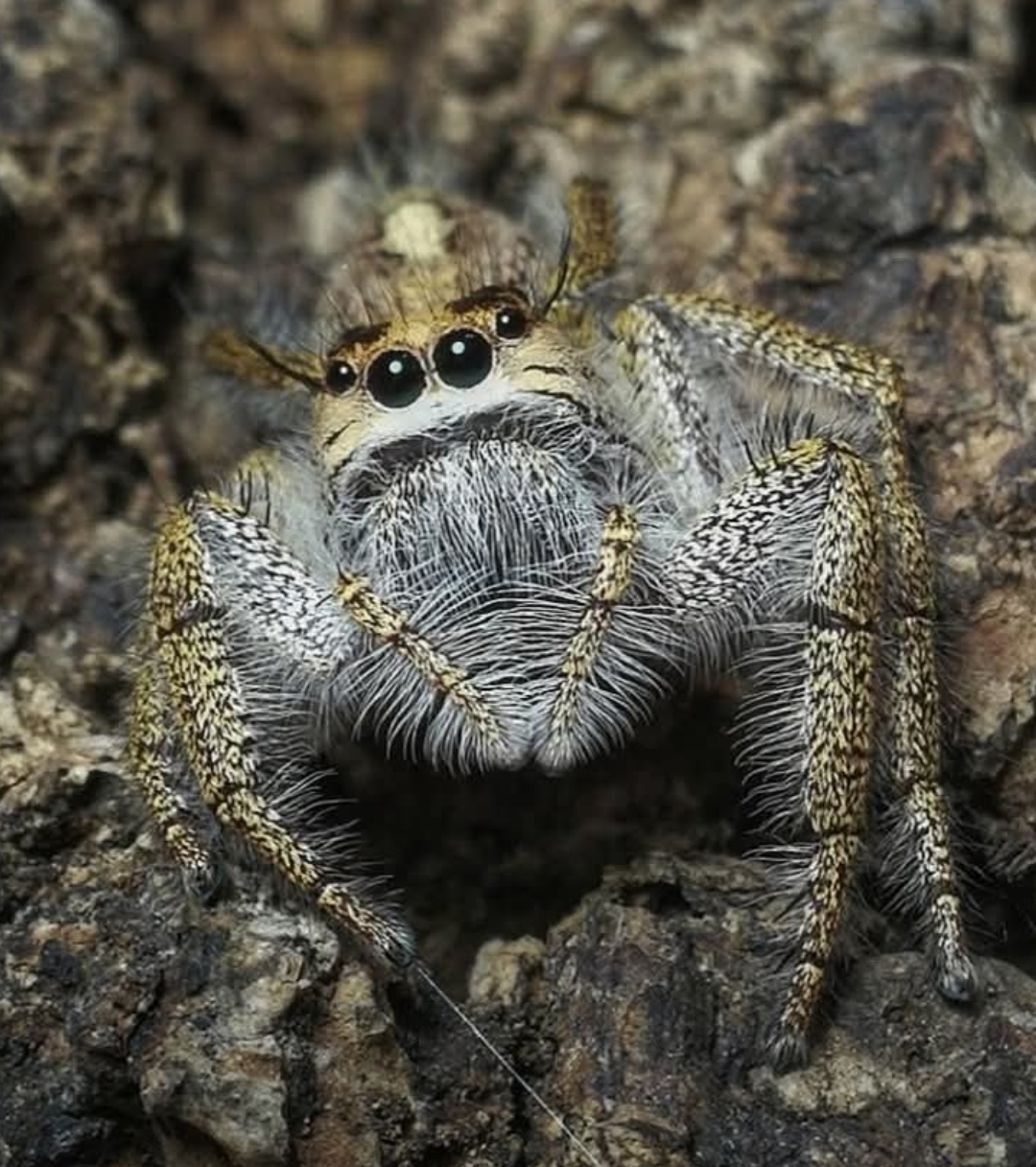
Hyllus walckenaeri
product unavailable
Description
Most jumping spiders fit on a fingernail. Hyllus walckenaeri makes you reconsider the whole family. This is the Salticidae form scaled up to a size that turns heads — a stalking, sight-hunting predator big enough that you watch it work the way you'd watch a cat, not an insect. It hails from sub-Saharan Africa: savannas, scrubland, and open sunlit terrain where prey moves in the daylight and a sharp-eyed hunter has the advantage.
The genus runs true to type — diurnal, visually oriented, hunting entirely by sight rather than web — but everything about Hyllus walckenaeri comes magnified. Adult females reach 15–20 mm in body length, placing this among the largest jumping spiders in the hobby. The body is dense with silver-grey setae broken by darker markings, and in males the chelicerae throw back a cold metallic flash when light catches them sideways. The build is compact and heavy-set, far stockier than the lighter frame of a Phidippus. With that bulk comes a decisiveness most keepers don't expect from a salticid: leaps are long and dead accurate, each one anchored with a silk dragline before the spider commits. Watch it run down a beetle and you're seeing what the Salticidae are capable of when you remove the size limit. Toward you it stays curious but measured — it observes rather than approaches, and its venom is medically insignificant to humans.
Give it height. The enclosure should be taller than wide — 20×20×30 cm at a minimum given the animal's size — with climbing structure in the upper half: cork bark, branches, or artificial foliage to anchor draglines and to hunt from. Two to four centimetres of coconut fibre on the floor is plenty. Keep humidity moderate with a regular light misting of the walls. Room temperature suits this species well, and it tolerates slightly warmer conditions without complaint. Offer feeder insects no larger than two-thirds of the spider's body length.
Hyllus walckenaeri is the natural step beyond Phidippus regius — the choice for a keeper who has lived with the small jumpers and wants to see the form at full expression. The care is straightforward; the real skill lies in moving slowly and calmly around an animal this aware, which is exactly the kind of patience it rewards. Keep one for a season and you'll find yourself building enclosures around it rather than the other way round — this is the jumping spider that, once kept, is rarely traded down for anything smaller.