






 Choose language
- Spiders
- ANIMALS
- Arachnids (Arachnida)
- Spiders (Araneae)
- Tarantulas (Mygalomorphae)
- Psednocnemis spp.
- Diplura spp.
- Spinosatibiapalpus spp.
- Acanthogonatus spp.
- Acanthoscurria spp.
- Amazonius spp.
- Ami spp.
- Anquasha spp.
- Aphonopelma spp.
- Aspinochilus spp.
- Augacephalus spp.
- Avicularia spp.
- Birupes spp.
- Bonnetina spp.
- Brachypelma spp.
- Bumba spp.
- Caribena spp.
- Ceratogyrus spp.
- Chaetopelma spp.
- Chilobrachys spp.
- Chromatopelma spp.
- Cilantica spp.
- Citharacanthus spp.
- Coremiocnemis spp.
- Cyclosternum spp.
- Cyriocosmus spp.
- Cyriopagopus spp.
- Davus spp.
- Dolichothele spp.
- Encyocratella spp.
- Ephebopus spp.
- Euathlus spp.
- Eucratoscelus spp.
- Eupalaestrus spp.
- Fufius spp.
- Gorgyrella spp.
- Grammostola spp.
- Guyruita spp.
- Hapalopus spp.
- Haploclastus spp.
- Haplocosmia spp.
- Haplopelma spp.
- Harpactira spp.
- Heteroscodra spp.
- Heterothele spp.
- Holothele spp.
- Homoeomma spp.
- Hysterocrates spp.
- Idiothele spp.
- Iridopelma spp.
- Kochiana spp.
- Lampropelma spp.
- Lasiocyano spp.
- Lasiodora spp.
- Lasiodorides spp.
- Linothele spp.
- Lyrognathus spp.
- Megaphobema spp.
- Monocentropus spp.
- Neischnocolus spp.
- Neoholothele spp.
- Neostenotarsus spp.
- Nhandu spp.
- Omothymus spp.
- Ornithoctoninae spp.
- Ornithoctonus spp.
- Pamphobeteus spp.
- Pelinobius spp.
- Phormictopus spp.
- Phormingochilus spp.
- Phrixotrichus spp.
- Poecilotheria spp.
- Psalmopoeus spp.
- Pseudhapalopus spp.
- Pseudoclamoris spp.
- Pterinochilus spp.
- Selenocosmia spp.
- Sericopelma spp.
- Tapinauchenius spp.
- Taksinus spp.
- Tapinauchenius spp.
- Theraphosa spp.
- Theraphosidae spp.
- Theraphosinae spp.
- Thrigmopoeus spp.
- Thrixopelma spp.
- Tliltocatl spp.
- Typhochlaena spp.
- Urupelma spp.
- Vitalius spp.
- Xenesthis spp.
- Ybyrapora spp.
- True Spiders (Araneomorphae)
- Velvet Spiders (Eresidae)
- Macrothele spp.
- Liphistius spp.
- Tarantulas (Mygalomorphae)
- Scorpions (Scorpiones)
- Spiders (Araneae)
- Insects - for feeding
- Arachnids (Arachnida)
- Scorpions
- Accessories
- Books
- Centipede
- Millipede
- Cockroaches
- New products
- Products on sale
Currency

€32.00
Regular price:
€40.00

€42.50
Regular price:
€50.00
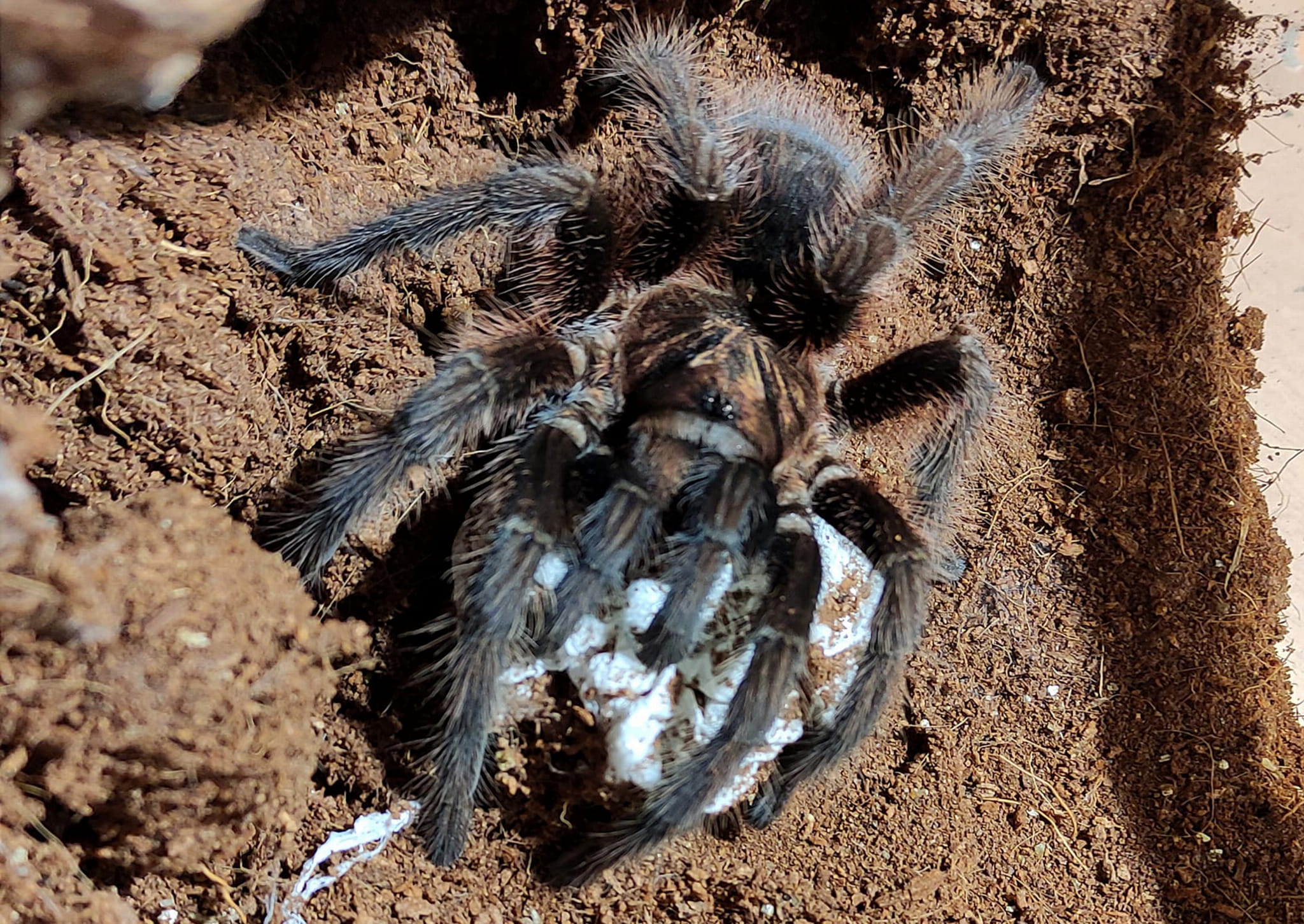
Species: Phormictopus cancerides
Common name: Haitian Brown Tarantula
Native range: Haiti, Dominican Republic (Hispaniola)
Temperature: 25–28 °C
Humidity: 65–70%
Adult size: 7 cm BL
Lifestyle: terrestrial
Speed: fast
Venom potency: mild
Temperament: defensive when disturbed
Recommended for: advanced keepers
Notes: Not CITES listed; no captive-bred documentation required.
Phormictopus cancerides
product unavailable
Description
Phormictopus cancerides is the kind of tarantula that fills an enclosure the moment it steps into it. Hailing from the humid forests of Hispaniola — the island shared by Haiti and the Dominican Republic — it carries the weight of that environment in every line of its build: a broad prosoma, thick walking legs, and a dark base coloration that shifts under warm light into burnished copper, with subtle violet undertones running through the setae. This isn't a spider that trades on novelty of form. It trades on sheer physical presence.
The temperament matches the build. Phormictopus cancerides is fast, decisive, and carries the full confidence of a terrestrial predator that has rarely had to concede ground. Feeding a mature female is less a routine task than an event — the appetite is considerable and the strike is committed. The species can kick urticating setae, though it does so less readily than many South American terrestrials; the first line of response here tends to be speed and posture rather than a bald patch.
House it in keeping with its origin: 7–10 cm of coconut fibre substrate, a sturdy hide toward one end of the enclosure, and a large water dish kept full. Humidity should run moderate to moderately high — misting one side of the enclosure maintains a gradient without saturating the whole setup. Cross-ventilation is important. Room temperature suits year-round keeping without supplemental heating.
Phormictopus cancerides rewards the keeper who has moved past their first few species and wants something with weight to it — not difficulty for its own sake, but presence. The copper tones deepen as the animal matures, and a fully grown female occupying a well-furnished enclosure carries the settled, unhurried authority of a lineage that has held Caribbean forests for a very long time. Years on, you'll find this isn't a spider you tuck away on a back shelf. It anchors the room it lives in.