






 Choose language
- Spiders
- ANIMALS
- Arachnids (Arachnida)
- Spiders (Araneae)
- Tarantulas (Mygalomorphae)
- Psednocnemis spp.
- Diplura spp.
- Spinosatibiapalpus spp.
- Acanthogonatus spp.
- Acanthoscurria spp.
- Amazonius spp.
- Ami spp.
- Anquasha spp.
- Aphonopelma spp.
- Aspinochilus spp.
- Augacephalus spp.
- Avicularia spp.
- Birupes spp.
- Bonnetina spp.
- Brachypelma spp.
- Bumba spp.
- Caribena spp.
- Ceratogyrus spp.
- Chaetopelma spp.
- Chilobrachys spp.
- Chromatopelma spp.
- Cilantica spp.
- Citharacanthus spp.
- Coremiocnemis spp.
- Cyclosternum spp.
- Cyriocosmus spp.
- Cyriopagopus spp.
- Davus spp.
- Dolichothele spp.
- Encyocratella spp.
- Ephebopus spp.
- Euathlus spp.
- Eucratoscelus spp.
- Eupalaestrus spp.
- Fufius spp.
- Gorgyrella spp.
- Grammostola spp.
- Guyruita spp.
- Hapalopus spp.
- Haploclastus spp.
- Haplocosmia spp.
- Haplopelma spp.
- Harpactira spp.
- Heteroscodra spp.
- Heterothele spp.
- Holothele spp.
- Homoeomma spp.
- Hysterocrates spp.
- Idiothele spp.
- Iridopelma spp.
- Kochiana spp.
- Lampropelma spp.
- Lasiocyano spp.
- Lasiodora spp.
- Lasiodorides spp.
- Linothele spp.
- Lyrognathus spp.
- Megaphobema spp.
- Monocentropus spp.
- Neischnocolus spp.
- Neoholothele spp.
- Neostenotarsus spp.
- Nhandu spp.
- Omothymus spp.
- Ornithoctoninae spp.
- Ornithoctonus spp.
- Pamphobeteus spp.
- Pelinobius spp.
- Phormictopus spp.
- Phormingochilus spp.
- Phrixotrichus spp.
- Poecilotheria spp.
- Psalmopoeus spp.
- Pseudhapalopus spp.
- Pseudoclamoris spp.
- Pterinochilus spp.
- Selenocosmia spp.
- Sericopelma spp.
- Tapinauchenius spp.
- Taksinus spp.
- Tapinauchenius spp.
- Theraphosa spp.
- Theraphosidae spp.
- Theraphosinae spp.
- Thrigmopoeus spp.
- Thrixopelma spp.
- Tliltocatl spp.
- Typhochlaena spp.
- Urupelma spp.
- Vitalius spp.
- Xenesthis spp.
- Ybyrapora spp.
- True Spiders (Araneomorphae)
- Velvet Spiders (Eresidae)
- Macrothele spp.
- Liphistius spp.
- Tarantulas (Mygalomorphae)
- Scorpions (Scorpiones)
- Spiders (Araneae)
- Insects - for feeding
- Arachnids (Arachnida)
- Scorpions
- Accessories
- Books
- Centipede
- Millipede
- Cockroaches
- New products
- Products on sale
Currency

€32.00
Regular price:
€40.00

€42.50
Regular price:
€50.00
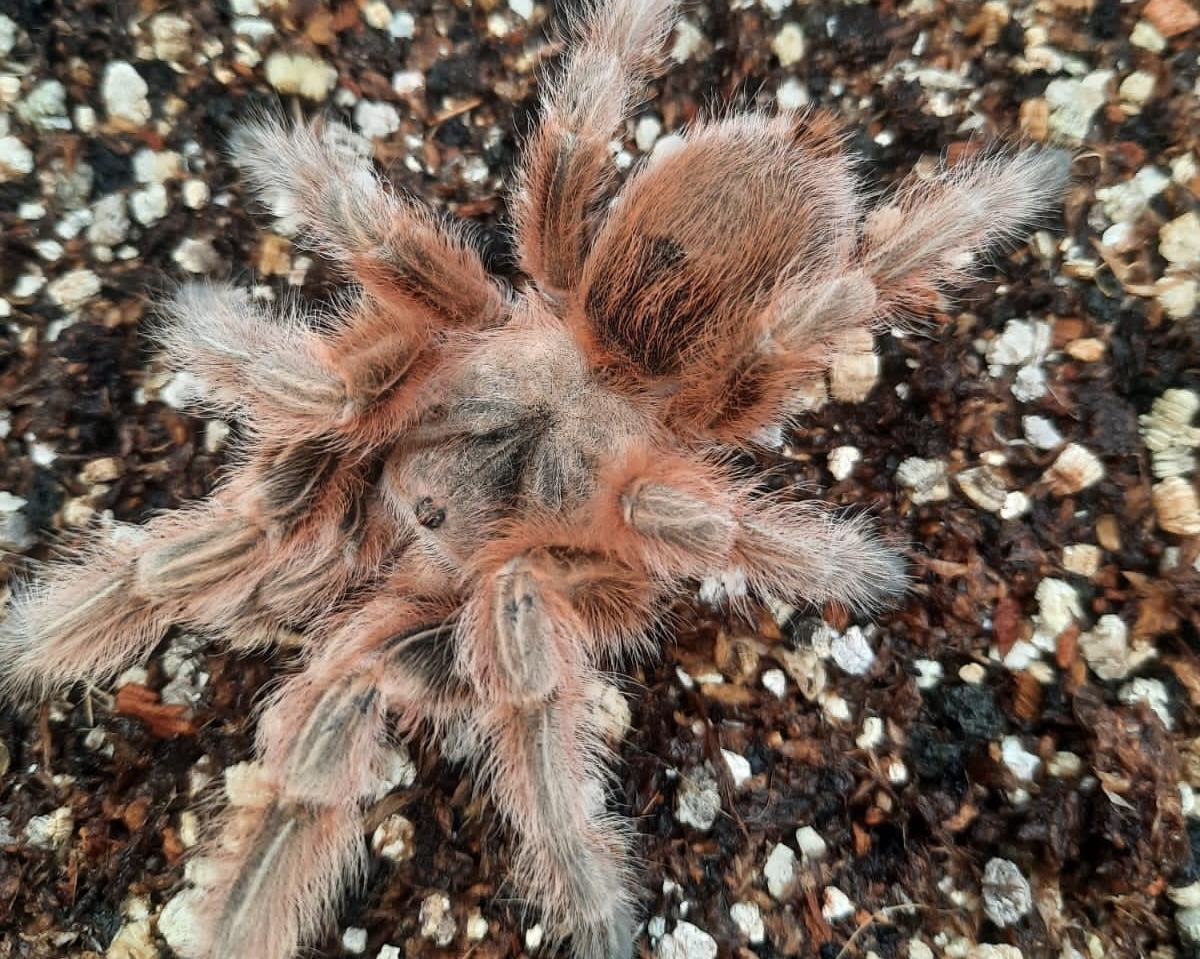
Species: Grammostola sp. Maule
Common name: -
Native range: Chile (Maule region)
Temperature: 20–24°C (room temperature, cool end preferred)
Humidity: 40–60%
Adult size: Females reach up to 7 cm BL
Lifestyle: Terrestrial
Speed: Slow
Venom potency: Mild
Temperament: Calm
Recommended for: Suitable for all keepers
Notes: This species does NOT require captive-bred documentation (CITES)
Grammostola sp. Maule
product unavailable
Description
From the narrow corridor between the Andes and the Pacific, in Chile's Maule region, comes a Grammostola that rewards a second look with a depth of colour few in the genus can match. Grammostola sp. Maule carries a deep rose-red across the body, warming into orange along the femora — an ember glow rendered in setae, unhurried and entirely unassuming. As an undescribed species it occupies that particular corner of a collection where taxonomy lags behind beauty, where a name is still catching up to something that already clearly exists. Among the Chilean Grammostola, it is a strong contender for the most visually arresting the country has produced.
The temperament follows the colour: warm, settled, undemanding. This is a terrestrial species with the slow, deliberate growth rate typical of the genus — the kind of animal that takes its time becoming itself. It poses no particular challenge in captivity, and its calm disposition means routine maintenance rarely provokes any response worth worrying about. What develops instead is a quiet familiarity, built over months and years rather than days.
The enclosure setup is straightforward. A mixture of coconut fibre and sand laid 5–7 cm deep suits the terrestrial lifestyle well. Provide a hide, a water dish, and keep most of the substrate dry with a small damp corner maintained through occasional misting. Room temperature is sufficient — if anything, erring toward the cooler end reflects the species' origins in central Chile more faithfully than warmth would.
Grammostola sp. Maule is a collector's purchase, most at home with a keeper who already follows the Chilean Grammostola and understands what makes that group worth following. It is rare, formally unnamed, and coloured like something a field naturalist might pause over and sketch before moving on — except that once one settles into a collection, very few keepers ever find a reason to move it along.