






 Choose language
- Spiders
- ANIMALS
- Arachnids (Arachnida)
- Spiders (Araneae)
- Tarantulas (Mygalomorphae)
- Psednocnemis spp.
- Diplura spp.
- Spinosatibiapalpus spp.
- Acanthogonatus spp.
- Acanthoscurria spp.
- Amazonius spp.
- Ami spp.
- Anquasha spp.
- Aphonopelma spp.
- Aspinochilus spp.
- Augacephalus spp.
- Avicularia spp.
- Birupes spp.
- Bonnetina spp.
- Brachypelma spp.
- Bumba spp.
- Caribena spp.
- Ceratogyrus spp.
- Chaetopelma spp.
- Chilobrachys spp.
- Chromatopelma spp.
- Cilantica spp.
- Citharacanthus spp.
- Coremiocnemis spp.
- Cyclosternum spp.
- Cyriocosmus spp.
- Cyriopagopus spp.
- Davus spp.
- Dolichothele spp.
- Encyocratella spp.
- Ephebopus spp.
- Euathlus spp.
- Eucratoscelus spp.
- Eupalaestrus spp.
- Fufius spp.
- Gorgyrella spp.
- Grammostola spp.
- Guyruita spp.
- Hapalopus spp.
- Haploclastus spp.
- Haplocosmia spp.
- Haplopelma spp.
- Harpactira spp.
- Heteroscodra spp.
- Heterothele spp.
- Holothele spp.
- Homoeomma spp.
- Hysterocrates spp.
- Idiothele spp.
- Iridopelma spp.
- Kochiana spp.
- Lampropelma spp.
- Lasiocyano spp.
- Lasiodora spp.
- Lasiodorides spp.
- Linothele spp.
- Lyrognathus spp.
- Megaphobema spp.
- Monocentropus spp.
- Neischnocolus spp.
- Neoholothele spp.
- Neostenotarsus spp.
- Nhandu spp.
- Omothymus spp.
- Ornithoctoninae spp.
- Ornithoctonus spp.
- Pamphobeteus spp.
- Pelinobius spp.
- Phormictopus spp.
- Phormingochilus spp.
- Phrixotrichus spp.
- Poecilotheria spp.
- Psalmopoeus spp.
- Pseudhapalopus spp.
- Pseudoclamoris spp.
- Pterinochilus spp.
- Selenocosmia spp.
- Sericopelma spp.
- Tapinauchenius spp.
- Taksinus spp.
- Tapinauchenius spp.
- Theraphosa spp.
- Theraphosidae spp.
- Theraphosinae spp.
- Thrigmopoeus spp.
- Thrixopelma spp.
- Tliltocatl spp.
- Typhochlaena spp.
- Urupelma spp.
- Vitalius spp.
- Xenesthis spp.
- Ybyrapora spp.
- True Spiders (Araneomorphae)
- Velvet Spiders (Eresidae)
- Macrothele spp.
- Liphistius spp.
- Tarantulas (Mygalomorphae)
- Scorpions (Scorpiones)
- Spiders (Araneae)
- Insects - for feeding
- Arachnids (Arachnida)
- Scorpions
- Accessories
- Books
- Centipede
- Millipede
- Cockroaches
- New products
- Products on sale
Currency

€42.50
Regular price:
€50.00

€32.00
Regular price:
€40.00
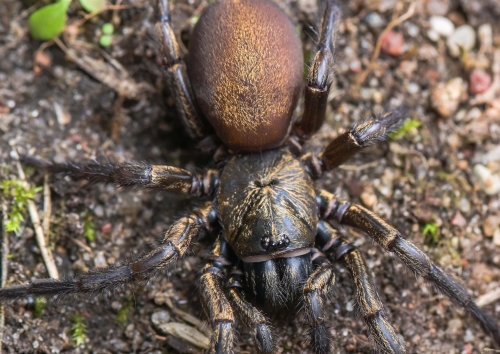


Species: Fufius lancius
Common name: -
Native range: Brazil (endemic)
Temperature: 26–28°C with a 2–3°C drop at night; room temperature is also fine
Humidity: 70–80%
Adult size: Females reach around 2.5 cm body length
Lifestyle: Fossorial
Speed: Moderate
Venom potency: Mild
Temperament: Calm
Recommended for: Suitable for all keepers
Notes: No CITES documentation required. Fufius lancius belongs to the family Cyrtaucheniidae (Mygalomorphae) — it is not a true tarantula (Theraphosidae).
Fufius lancius
product unavailable
Description
Most keepers spend years inside Theraphosidae without realising how much of Mygalomorphae lies just outside it. Fufius lancius is one of those quiet doorways out — a small, dark, burrowing mygalomorph from the humid forests of Brazil, belonging to the family Cyrtaucheniidae rather than to the true tarantulas. Its body is compact and deeply pigmented, a brown-black that reads almost geological, and every line of its build seems shaped around a single purpose: going underground and staying there.
In captivity, Fufius lancius is calm and profoundly secretive. It will spend the great majority of its time inside its burrow, emerging only under cover of darkness with no interest in performing for an audience. This is not a species that rewards passive watching in the usual sense — it rewards patience, and the particular satisfaction of knowing something is thriving precisely because you have understood and respected its nature. Appetite is moderate and consistent.
The enclosure should reflect the species' fossorial lifestyle. At least 10 cm of moist substrate — coconut fibre mixed with organic topsoil works well — gives Fufius lancius the depth it needs to construct a proper burrow. Provide a starter hide, a water dish, and keep one area damp through regular misting, with good cross-ventilation to prevent stagnant air. Room temperature is fine.
Fufius lancius suits the keeper who has moved deliberately past the familiar and is building a collection around taxonomic breadth rather than spectacle. It appears rarely on availability lists, and when it does, it tends to find its way to people who already know why that matters. If you are drawn to the quieter edges of Mygalomorphae — to animals that ask more of the keeper's imagination than of their attention — Fufius lancius will hold its place on the shelf for years without ever once feeling ordinary.