






 Choose language
- Spiders
- ANIMALS
- Arachnids (Arachnida)
- Spiders (Araneae)
- Tarantulas (Mygalomorphae)
- Psednocnemis spp.
- Diplura spp.
- Spinosatibiapalpus spp.
- Acanthogonatus spp.
- Acanthoscurria spp.
- Amazonius spp.
- Ami spp.
- Anquasha spp.
- Aphonopelma spp.
- Aspinochilus spp.
- Augacephalus spp.
- Avicularia spp.
- Birupes spp.
- Bonnetina spp.
- Brachypelma spp.
- Bumba spp.
- Caribena spp.
- Ceratogyrus spp.
- Chaetopelma spp.
- Chilobrachys spp.
- Chromatopelma spp.
- Cilantica spp.
- Citharacanthus spp.
- Coremiocnemis spp.
- Cyclosternum spp.
- Cyriocosmus spp.
- Cyriopagopus spp.
- Davus spp.
- Dolichothele spp.
- Encyocratella spp.
- Ephebopus spp.
- Euathlus spp.
- Eucratoscelus spp.
- Eupalaestrus spp.
- Fufius spp.
- Gorgyrella spp.
- Grammostola spp.
- Guyruita spp.
- Hapalopus spp.
- Haploclastus spp.
- Haplocosmia spp.
- Haplopelma spp.
- Harpactira spp.
- Heteroscodra spp.
- Heterothele spp.
- Holothele spp.
- Homoeomma spp.
- Hysterocrates spp.
- Idiothele spp.
- Iridopelma spp.
- Kochiana spp.
- Lampropelma spp.
- Lasiocyano spp.
- Lasiodora spp.
- Lasiodorides spp.
- Linothele spp.
- Lyrognathus spp.
- Megaphobema spp.
- Monocentropus spp.
- Neischnocolus spp.
- Neoholothele spp.
- Neostenotarsus spp.
- Nhandu spp.
- Omothymus spp.
- Ornithoctoninae spp.
- Ornithoctonus spp.
- Pamphobeteus spp.
- Pelinobius spp.
- Phormictopus spp.
- Phormingochilus spp.
- Phrixotrichus spp.
- Poecilotheria spp.
- Psalmopoeus spp.
- Pseudhapalopus spp.
- Pseudoclamoris spp.
- Pterinochilus spp.
- Selenocosmia spp.
- Sericopelma spp.
- Tapinauchenius spp.
- Taksinus spp.
- Tapinauchenius spp.
- Theraphosa spp.
- Theraphosidae spp.
- Theraphosinae spp.
- Thrigmopoeus spp.
- Thrixopelma spp.
- Tliltocatl spp.
- Typhochlaena spp.
- Urupelma spp.
- Vitalius spp.
- Xenesthis spp.
- Ybyrapora spp.
- True Spiders (Araneomorphae)
- Velvet Spiders (Eresidae)
- Macrothele spp.
- Liphistius spp.
- Tarantulas (Mygalomorphae)
- Scorpions (Scorpiones)
- Spiders (Araneae)
- Insects - for feeding
- Arachnids (Arachnida)
- Scorpions
- Accessories
- Books
- Centipede
- Millipede
- Cockroaches
- New products
- Products on sale
Currency

€32.00
Regular price:
€40.00

€42.50
Regular price:
€50.00
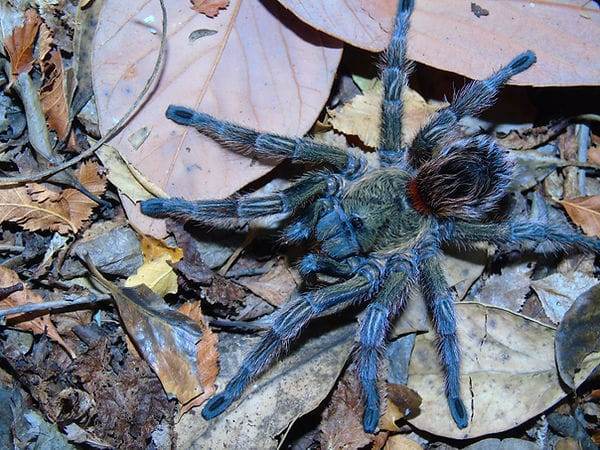
Species: Euathlus manicata green
Common name: -
Native range: Chile
Temperature: 23–25°C with a 2–3°C drop at night; also does well at room temperature
Humidity: 60–70%
Adult size: Females reach up to 4 cm in body length
Lifestyle: Terrestrial
Speed: Slow
Venom potency: Mild
Temperament: Calm
Recommended for: All keeper experience levels
Notes: Not listed under CITES; no captive-bred documentation required
Euathlus manicata green
product unavailable
Description
Green is a colour you rarely meet in a tarantula, and Euathlus manicata green wears it like a secret. The body sits dark at first glance, but tilt the enclosure into the light and an olive-green iridescence rises through the setae — visible only at the right angle, gone the moment you move. Among the colour forms of Euathlus manicata, this is the one that stops collectors mid-scroll, and it earns the attention by understatement rather than spectacle.
Temperament follows the Euathlus manicata pattern faithfully — calm, unhurried, tolerant of routine husbandry without complaint. Growth is slow, paced by the cooler conditions of its Chilean range, and the terrestrial lifestyle keeps most of its life played out at substrate level where it is easy to watch without disturbance. This is not a spider that performs; it simply exists with a quiet dignity that experienced keepers come to appreciate more, not less, over time.
Setup is modest. A 5–7 cm layer of coconut fibre mixed with sand makes an appropriate terrestrial substrate. A cork hide and a water dish complete the enclosure. The majority of the substrate should stay dry, with one small area receiving occasional, light misting. Room temperature — or slightly cooler, in keeping with its Chilean highland origin — is sufficient. Appropriately sized prey offered at relaxed intervals keeps this slow-growing species in good condition without overfeeding.
Euathlus manicata green is the rarest colour form within a genus already sought after for its gentle disposition, and that combination of scarcity and tractability is what keeps it on serious wishlists. A keeper who acquires one tends to find it still in the same enclosure, in the same corner of the collection, years later — still catching the light at unexpected moments, still throwing that faint green gleam that reminds them exactly why they wanted it in the first place.