






 Choose language
- Spiders
- ANIMALS
- Arachnids (Arachnida)
- Spiders (Araneae)
- Tarantulas (Mygalomorphae)
- Psednocnemis spp.
- Diplura spp.
- Spinosatibiapalpus spp.
- Acanthogonatus spp.
- Acanthoscurria spp.
- Amazonius spp.
- Ami spp.
- Anquasha spp.
- Aphonopelma spp.
- Aspinochilus spp.
- Augacephalus spp.
- Avicularia spp.
- Birupes spp.
- Bonnetina spp.
- Brachypelma spp.
- Bumba spp.
- Caribena spp.
- Ceratogyrus spp.
- Chaetopelma spp.
- Chilobrachys spp.
- Chromatopelma spp.
- Cilantica spp.
- Citharacanthus spp.
- Coremiocnemis spp.
- Cyclosternum spp.
- Cyriocosmus spp.
- Cyriopagopus spp.
- Davus spp.
- Dolichothele spp.
- Encyocratella spp.
- Ephebopus spp.
- Euathlus spp.
- Eucratoscelus spp.
- Eupalaestrus spp.
- Fufius spp.
- Gorgyrella spp.
- Grammostola spp.
- Guyruita spp.
- Hapalopus spp.
- Haploclastus spp.
- Haplocosmia spp.
- Haplopelma spp.
- Harpactira spp.
- Heteroscodra spp.
- Heterothele spp.
- Holothele spp.
- Homoeomma spp.
- Hysterocrates spp.
- Idiothele spp.
- Iridopelma spp.
- Kochiana spp.
- Lampropelma spp.
- Lasiocyano spp.
- Lasiodora spp.
- Lasiodorides spp.
- Linothele spp.
- Lyrognathus spp.
- Megaphobema spp.
- Monocentropus spp.
- Neischnocolus spp.
- Neoholothele spp.
- Neostenotarsus spp.
- Nhandu spp.
- Omothymus spp.
- Ornithoctoninae spp.
- Ornithoctonus spp.
- Pamphobeteus spp.
- Pelinobius spp.
- Phormictopus spp.
- Phormingochilus spp.
- Phrixotrichus spp.
- Poecilotheria spp.
- Psalmopoeus spp.
- Pseudhapalopus spp.
- Pseudoclamoris spp.
- Pterinochilus spp.
- Selenocosmia spp.
- Sericopelma spp.
- Tapinauchenius spp.
- Taksinus spp.
- Tapinauchenius spp.
- Theraphosa spp.
- Theraphosidae spp.
- Theraphosinae spp.
- Thrigmopoeus spp.
- Thrixopelma spp.
- Tliltocatl spp.
- Typhochlaena spp.
- Urupelma spp.
- Vitalius spp.
- Xenesthis spp.
- Ybyrapora spp.
- True Spiders (Araneomorphae)
- Velvet Spiders (Eresidae)
- Macrothele spp.
- Liphistius spp.
- Tarantulas (Mygalomorphae)
- Scorpions (Scorpiones)
- Spiders (Araneae)
- Insects - for feeding
- Arachnids (Arachnida)
- Scorpions
- Accessories
- Books
- Centipede
- Millipede
- Cockroaches
- New products
- Products on sale
Currency

€32.00
Regular price:
€40.00

€42.50
Regular price:
€50.00
Species: Ephebopus uatuman
Common name: -
Native range: Brazil (Amazonas, Uatumã river basin)
Temperature: 25–28°C, with a 2–3°C drop at night; room temperature is generally sufficient
Humidity: 70–80%
Adult size: Females reach 4–5 cm body length
Lifestyle: Fossorial
Speed: Fast
Venom potency: Moderate
Temperament: Defensive when disturbed; flicks urticating setae from the pedipalps
Recommended for: Intermediate keepers
Notes: Not listed under CITES; no captive-bred documentation required
Ephebopus uatuman
product unavailable
Description
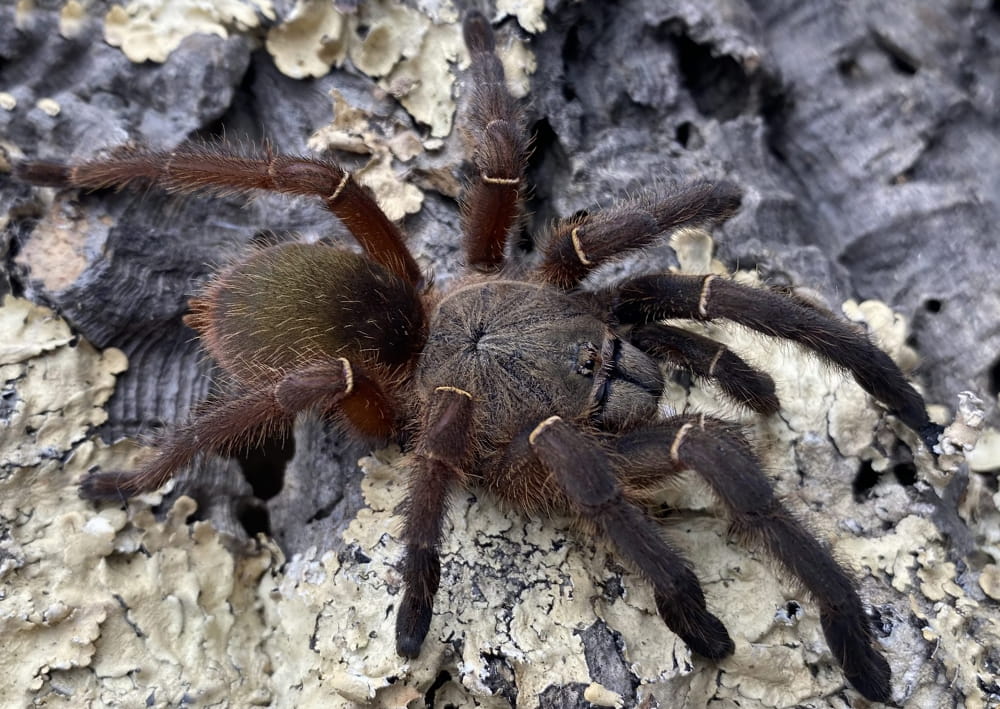
Few tarantulas defend themselves the way Ephebopus uatuman does, and that single fact is reason enough to want one. Native to the humid lowland forests of Brazilian Amazonia — specifically the Uatumã river basin in Amazonas state — this is a compact, lightly built species whose colour rewards a slow second look. Against a deep chocolate-brown body, the prosoma carries a cool metallic shimmer that shifts between silver and pale green depending on how the light catches it, and adult pedipalps are tipped with a brighter contrasting tone. Across the genus Ephebopus this understated metallic quality is a shared signature, but Ephebopus uatuman wears it with particular restraint.
What truly sets the genus Ephebopus apart is a defensive mechanism found in almost no other theraphosids: the urticating setae sit not on the opisthosoma, as in most New World species, but on the pedipalps. When provoked, Ephebopus uatuman rubs its pedipalps together and flicks setae directly at the threat — a precise, targeted release unlike anything else in the family, and the kind of behaviour that, once witnessed, anchors a species permanently in memory. Beyond that, Ephebopus uatuman is fossorial and cryptic by nature, constructing deep silk-lined burrows in the wild and spending most of its life within them, posting up at the entrance after dark to ambush passing prey. Reflexes are fast, venom moderate, temperament defensive rather than erratic.
In the enclosure, give Ephebopus uatuman a fossorial setup with 12–15 cm of substrate — coconut fibre mixed with a loamy component works well — kept at moderate to high humidity, with most of the substrate damp and the walls misted regularly. A cork tube laid on the surface offers a starting point for excavation and is usually accepted within days. Room temperature is sufficient. Provide a water dish for adults and larger juveniles; spiderlings will drink from droplets on the walls after misting. Cross-ventilation is essential — steady airflow prevents stagnation in a humid setup without drying it out.
This is a species for intermediate keepers who have moved past the basics and are ready to observe something genuinely unusual. It asks for careful maintenance and a measured approach during enclosure work, given its speed and fossorial habits, but in return offers a behavioural window available in no other genus. Watching a tarantula comb its own pedipalps to release a cloud of urticating setae is not something you forget, and not something any other spider in your collection will replicate. Months in, you'll likely find yourself still rearranging the maintenance routine around the small dark entrance of that burrow — and wouldn't have it any other way.