






 Choose language
- Spiders
- ANIMALS
- Arachnids (Arachnida)
- Spiders (Araneae)
- Tarantulas (Mygalomorphae)
- Psednocnemis spp.
- Diplura spp.
- Spinosatibiapalpus spp.
- Acanthogonatus spp.
- Acanthoscurria spp.
- Amazonius spp.
- Ami spp.
- Anquasha spp.
- Aphonopelma spp.
- Aspinochilus spp.
- Augacephalus spp.
- Avicularia spp.
- Birupes spp.
- Bonnetina spp.
- Brachypelma spp.
- Bumba spp.
- Caribena spp.
- Ceratogyrus spp.
- Chaetopelma spp.
- Chilobrachys spp.
- Chromatopelma spp.
- Cilantica spp.
- Citharacanthus spp.
- Coremiocnemis spp.
- Cyclosternum spp.
- Cyriocosmus spp.
- Cyriopagopus spp.
- Davus spp.
- Dolichothele spp.
- Encyocratella spp.
- Ephebopus spp.
- Euathlus spp.
- Eucratoscelus spp.
- Eupalaestrus spp.
- Fufius spp.
- Gorgyrella spp.
- Grammostola spp.
- Guyruita spp.
- Hapalopus spp.
- Haploclastus spp.
- Haplocosmia spp.
- Haplopelma spp.
- Harpactira spp.
- Heteroscodra spp.
- Heterothele spp.
- Holothele spp.
- Homoeomma spp.
- Hysterocrates spp.
- Idiothele spp.
- Iridopelma spp.
- Kochiana spp.
- Lampropelma spp.
- Lasiocyano spp.
- Lasiodora spp.
- Lasiodorides spp.
- Linothele spp.
- Lyrognathus spp.
- Megaphobema spp.
- Monocentropus spp.
- Neischnocolus spp.
- Neoholothele spp.
- Neostenotarsus spp.
- Nhandu spp.
- Omothymus spp.
- Ornithoctoninae spp.
- Ornithoctonus spp.
- Pamphobeteus spp.
- Pelinobius spp.
- Phormictopus spp.
- Phormingochilus spp.
- Phrixotrichus spp.
- Poecilotheria spp.
- Psalmopoeus spp.
- Pseudhapalopus spp.
- Pseudoclamoris spp.
- Pterinochilus spp.
- Selenocosmia spp.
- Sericopelma spp.
- Tapinauchenius spp.
- Taksinus spp.
- Tapinauchenius spp.
- Theraphosa spp.
- Theraphosidae spp.
- Theraphosinae spp.
- Thrigmopoeus spp.
- Thrixopelma spp.
- Tliltocatl spp.
- Typhochlaena spp.
- Urupelma spp.
- Vitalius spp.
- Xenesthis spp.
- Ybyrapora spp.
- True Spiders (Araneomorphae)
- Velvet Spiders (Eresidae)
- Macrothele spp.
- Liphistius spp.
- Tarantulas (Mygalomorphae)
- Scorpions (Scorpiones)
- Spiders (Araneae)
- Insects - for feeding
- Arachnids (Arachnida)
- Scorpions
- Accessories
- Books
- Centipede
- Millipede
- Cockroaches
- New products
- Products on sale
Currency

€32.00
Regular price:
€40.00

€42.50
Regular price:
€50.00
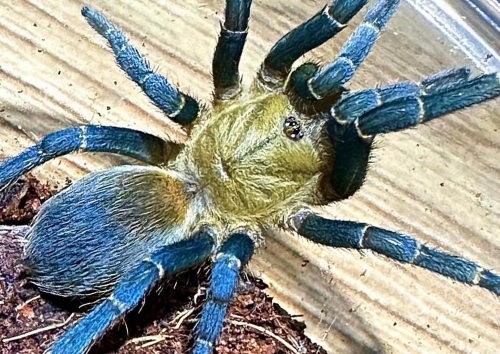


Species: Cyclosternum sp. Aureum
Common name: -
Native range: Central America
Temperature: 24–27°C
Humidity: 65–75%
Adult size: 3–4 cm BL
Lifestyle: Terrestrial
Speed: Moderate
Venom potency: Mild
Temperament: Calm, not particularly defensive
Recommended for: Keepers with basic experience
First spider: No
Notes: A rare, undescribed species of Cyclosternum
Cyclosternum sp. Aureum
product unavailable
Description
Gold is a rare colour in the tarantula world, and Cyclosternum sp. Aureum wears it without fuss. Warm amber tones wash across the carapace and abdomen, lit from within rather than painted on — the trade name takes its cue from the Latin aureum, meaning golden, and once you've seen the animal in person the etymology argues itself. This is a small, compact Central American terrestrial whose exact range is still being sorted out among hobbyists, and one of the quieter rewards of keeping less-described species is that you're observing an animal whose story is still being written.
The temperament is the second pleasant surprise. Cyclosternum sp. Aureum is calm without disappearing for weeks on end, terrestrial in habit, and largely unbothered by the comings and goings of a household. Its appetite is moderate and its growth unhurried — a spider that invites patience rather than demands it. There are no theatrical threat postures here, no bolts across the enclosure; what you get instead is a small golden animal that simply gets on with being itself in plain view.
Husbandry is refreshingly uncomplicated. A modest enclosure with roughly 5 cm of coconut fibre substrate, a cork hide, and a small water dish covers the essentials. Keep humidity moderate by misting one corner periodically rather than saturating the whole substrate, and room temperature is perfectly adequate year-round. The enclosure needn't be large — this is a species that uses small spaces well and rewards careful, close-range observation.
For the keeper who has worked through a few common species and wants something less seen, Cyclosternum sp. Aureum offers a long, slow relationship with an animal still largely undocumented. Years from now you may well find yourself contributing observations on growth, behaviour, and breeding that the literature simply doesn't yet contain — and that quiet act of building knowledge alongside a small golden spider is the sort of thing that keeps people in this hobby for decades.