






 Choose language
- Spiders
- ANIMALS
- Arachnids (Arachnida)
- Spiders (Araneae)
- Tarantulas (Mygalomorphae)
- Psednocnemis spp.
- Diplura spp.
- Spinosatibiapalpus spp.
- Acanthogonatus spp.
- Acanthoscurria spp.
- Amazonius spp.
- Ami spp.
- Anquasha spp.
- Aphonopelma spp.
- Aspinochilus spp.
- Augacephalus spp.
- Avicularia spp.
- Birupes spp.
- Bonnetina spp.
- Brachypelma spp.
- Bumba spp.
- Caribena spp.
- Ceratogyrus spp.
- Chaetopelma spp.
- Chilobrachys spp.
- Chromatopelma spp.
- Cilantica spp.
- Citharacanthus spp.
- Coremiocnemis spp.
- Cyclosternum spp.
- Cyriocosmus spp.
- Cyriopagopus spp.
- Davus spp.
- Dolichothele spp.
- Encyocratella spp.
- Ephebopus spp.
- Euathlus spp.
- Eucratoscelus spp.
- Eupalaestrus spp.
- Fufius spp.
- Gorgyrella spp.
- Grammostola spp.
- Guyruita spp.
- Hapalopus spp.
- Haploclastus spp.
- Haplocosmia spp.
- Haplopelma spp.
- Harpactira spp.
- Heteroscodra spp.
- Heterothele spp.
- Holothele spp.
- Homoeomma spp.
- Hysterocrates spp.
- Idiothele spp.
- Iridopelma spp.
- Kochiana spp.
- Lampropelma spp.
- Lasiocyano spp.
- Lasiodora spp.
- Lasiodorides spp.
- Linothele spp.
- Lyrognathus spp.
- Megaphobema spp.
- Monocentropus spp.
- Neischnocolus spp.
- Neoholothele spp.
- Neostenotarsus spp.
- Nhandu spp.
- Omothymus spp.
- Ornithoctoninae spp.
- Ornithoctonus spp.
- Pamphobeteus spp.
- Pelinobius spp.
- Phormictopus spp.
- Phormingochilus spp.
- Phrixotrichus spp.
- Poecilotheria spp.
- Psalmopoeus spp.
- Pseudhapalopus spp.
- Pseudoclamoris spp.
- Pterinochilus spp.
- Selenocosmia spp.
- Sericopelma spp.
- Tapinauchenius spp.
- Taksinus spp.
- Tapinauchenius spp.
- Theraphosa spp.
- Theraphosidae spp.
- Theraphosinae spp.
- Thrigmopoeus spp.
- Thrixopelma spp.
- Tliltocatl spp.
- Typhochlaena spp.
- Urupelma spp.
- Vitalius spp.
- Xenesthis spp.
- Ybyrapora spp.
- True Spiders (Araneomorphae)
- Velvet Spiders (Eresidae)
- Macrothele spp.
- Liphistius spp.
- Tarantulas (Mygalomorphae)
- Scorpions (Scorpiones)
- Spiders (Araneae)
- Insects - for feeding
- Arachnids (Arachnida)
- Scorpions
- Accessories
- Books
- Centipede
- Millipede
- Cockroaches
- New products
- Products on sale
Currency

€32.00
Regular price:
€40.00

€42.50
Regular price:
€50.00
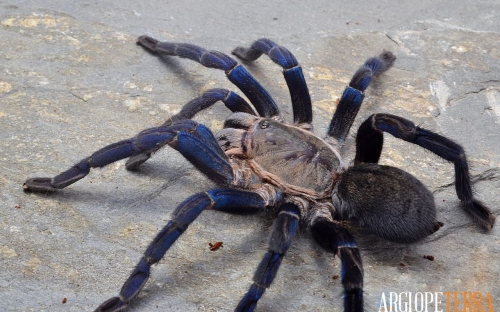


Species: Cyriopagopus lividus
Common name: Cobalt Blue Tarantula
Native range: Myanmar and Thailand
Temperature: 25–28°C by day, with a 2–3°C drop at night; room temperature also tolerated
Humidity: 70–80%
Adult size: Females reach 6–7 cm in body length
Lifestyle: Fossorial
Speed: Very fast
Venom potency: Potent, though not considered medically significant for a healthy adult
Temperament: Defensive and quick to react; will strike without hesitation
Recommended for: Advanced keepers
Notes: No CITES documentation required
Melopoeus lividus
product unavailable
Description
Few Old World tarantulas stop a keeper mid-step the way Cyriopagopus lividus does. The metallic cobalt blue catching the light at the burrow entrance is so saturated it reads almost electric — a colour that seems wrong for something living its life underground in the leaf litter of Myanmar and Thailand. And yet that fleeting glimpse, framed against dark substrate, is precisely the reward this species offers: brief, deliberate, and entirely on its own terms.
This is a fossorial animal first and foremost, engineering deep, architecturally precise burrows with the efficiency of a species that has never needed to negotiate with the world above. Experienced keepers will tell you Cyriopagopus lividus watches the enclosure as intently as you watch it. It carries no urticating setae, so there is no warning flick, no preliminary gesture — the threat posture here is the prelude to action, not a bluff. Paradoxically, that directness is part of what makes long-term observation so compelling: you learn to read the animal's stillness as fluently as its movement, and the line between the two is finer than it looks.
Husbandry centres on replicating the humid, warm conditions of its native lowland forests. An enclosure of roughly 30 × 25 × 30 cm suits an adult well; depth matters more than floor area, and at least 10 cm of substrate — coconut fibre, or a coconut fibre and peat blend — should be offered so the animal can burrow naturally. Humidity in the 70–80% range keeps it comfortable, with a water dish and a piece of cork bark at the surface completing the setup. Aim for 25–28°C by day with a modest drop at night, though room temperature is generally tolerated. Cross-ventilation matters here — stagnant, wet air is far more dangerous than any brief dip in humidity. Feed appropriately sized prey at intervals that match the animal's activity and season.
Cyriopagopus lividus is a species for keepers who have already moved past their first Old World tarantulas — not as a warning dressed up as mystique, but as straightforward guidance. The venom is not considered medically significant for a healthy adult, but the speed and defensive temperament leave little room for distraction during routine maintenance. What you get in return for that respect is a presence that does not fade with familiarity. Years from now, the moment that blue appears at the burrow entrance will still stop you mid-thought.