






 Choose language
- Spiders
- ANIMALS
- Arachnids (Arachnida)
- Spiders (Araneae)
- Tarantulas (Mygalomorphae)
- Psednocnemis spp.
- Diplura spp.
- Spinosatibiapalpus spp.
- Acanthogonatus spp.
- Acanthoscurria spp.
- Amazonius spp.
- Ami spp.
- Anquasha spp.
- Aphonopelma spp.
- Aspinochilus spp.
- Augacephalus spp.
- Avicularia spp.
- Birupes spp.
- Bonnetina spp.
- Brachypelma spp.
- Bumba spp.
- Caribena spp.
- Ceratogyrus spp.
- Chaetopelma spp.
- Chilobrachys spp.
- Chromatopelma spp.
- Cilantica spp.
- Citharacanthus spp.
- Coremiocnemis spp.
- Cyclosternum spp.
- Cyriocosmus spp.
- Cyriopagopus spp.
- Davus spp.
- Dolichothele spp.
- Encyocratella spp.
- Ephebopus spp.
- Euathlus spp.
- Eucratoscelus spp.
- Eupalaestrus spp.
- Fufius spp.
- Gorgyrella spp.
- Grammostola spp.
- Guyruita spp.
- Hapalopus spp.
- Haploclastus spp.
- Haplocosmia spp.
- Haplopelma spp.
- Harpactira spp.
- Heteroscodra spp.
- Heterothele spp.
- Holothele spp.
- Homoeomma spp.
- Hysterocrates spp.
- Idiothele spp.
- Iridopelma spp.
- Kochiana spp.
- Lampropelma spp.
- Lasiocyano spp.
- Lasiodora spp.
- Lasiodorides spp.
- Linothele spp.
- Lyrognathus spp.
- Megaphobema spp.
- Monocentropus spp.
- Neischnocolus spp.
- Neoholothele spp.
- Neostenotarsus spp.
- Nhandu spp.
- Omothymus spp.
- Ornithoctoninae spp.
- Ornithoctonus spp.
- Pamphobeteus spp.
- Pelinobius spp.
- Phormictopus spp.
- Phormingochilus spp.
- Phrixotrichus spp.
- Poecilotheria spp.
- Psalmopoeus spp.
- Pseudhapalopus spp.
- Pseudoclamoris spp.
- Pterinochilus spp.
- Selenocosmia spp.
- Sericopelma spp.
- Tapinauchenius spp.
- Taksinus spp.
- Tapinauchenius spp.
- Theraphosa spp.
- Theraphosidae spp.
- Theraphosinae spp.
- Thrigmopoeus spp.
- Thrixopelma spp.
- Tliltocatl spp.
- Typhochlaena spp.
- Urupelma spp.
- Vitalius spp.
- Xenesthis spp.
- Ybyrapora spp.
- True Spiders (Araneomorphae)
- Velvet Spiders (Eresidae)
- Macrothele spp.
- Liphistius spp.
- Tarantulas (Mygalomorphae)
- Scorpions (Scorpiones)
- Spiders (Araneae)
- Insects - for feeding
- Arachnids (Arachnida)
- Scorpions
- Accessories
- Books
- Centipede
- Millipede
- Cockroaches
- New products
- Products on sale
Currency

€42.50
Regular price:
€50.00

€32.00
Regular price:
€40.00
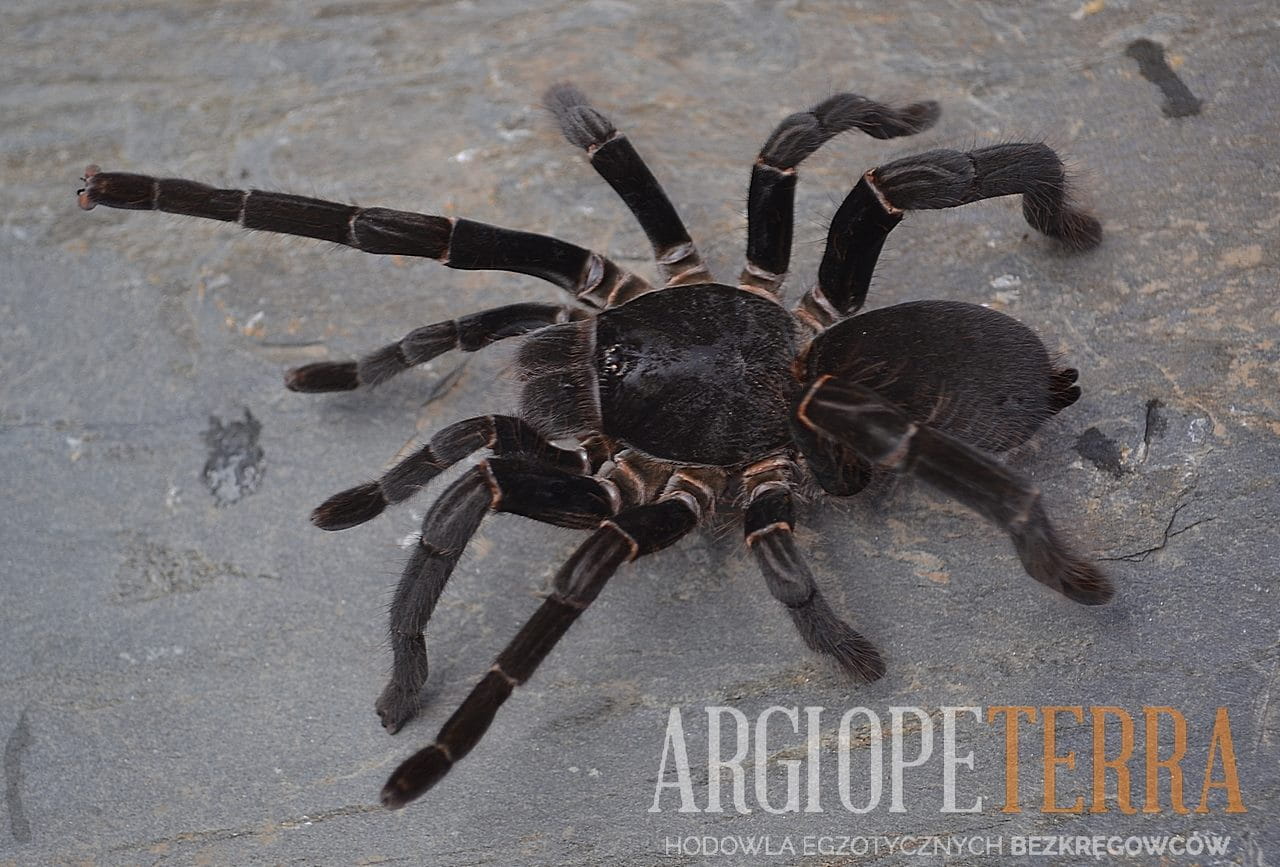
Species: Hysterocrates gigas
Common name: Cameroon Red Baboon
Native range: Cameroon, Nigeria
Temperature: 24–28°C; tolerates room temperature
Humidity: 70–85%
Adult size: Females reach 8–9 cm body length
Lifestyle: Fossorial
Speed: Fast
Venom potency: Potent
Temperament: Defensive when disturbed
Recommended for: Advanced keepers
Notes: Not CITES listed; no captive-bred documentation required
Hysterocrates gigas
product unavailable
Description
Few tarantulas occupy space the way Hysterocrates gigas does. This is a heavy, deliberate African fossorial that lives close to standing and slow-moving water in the humid forests of Cameroon and Nigeria — a detail that shapes nearly every aspect of how it should be kept. Fresh from a moult the body carries a deep graphite tone that gradually settles into dark brown with a faint auburn cast, like old mahogany seen in low light. The species name means "giant," and adult females earn it: among the most massively built fossorial spiders on the continent, with a presence that fills any enclosure they occupy.
Size here does not translate to slowness. Hysterocrates gigas is fast, decisive, and unapologetically defensive — the kind of animal that reminds you, without theatrics, that it has the better claim to the space. It digs deep, it eats with conviction, and watching a fully grown female take down appropriately sized prey is one of those feeding responses that stays with you long after the lid goes back on.
Husbandry follows directly from the species' origins. Offer a minimum of 10 cm of substrate — a moist blend of coconut fibre and topsoil that holds a burrow's shape without collapsing. A large water dish is not optional; Hysterocrates gigas drinks regularly and benefits from permanent access to standing water. Keep the substrate damp rather than wet, with temperatures between 24–28°C. Floor space matters too — give this animal room, because a cramped setup will be immediately and persistently remodelled to its own specifications.
This is a spider for keepers who have moved past the question of whether size alone is reason enough to keep something. It isn't — but the reason to keep Hysterocrates gigas is to live alongside a large, fossorial Old World tarantula with genuine weight to it. Once settled into a well-built burrow system, it becomes the kind of long-term resident you find yourself checking on not out of concern, but out of the quiet satisfaction of watching something substantial live entirely on its own terms.