






 Choose language
- Spiders
- ANIMALS
- Arachnids (Arachnida)
- Spiders (Araneae)
- Tarantulas (Mygalomorphae)
- Psednocnemis spp.
- Diplura spp.
- Spinosatibiapalpus spp.
- Acanthogonatus spp.
- Acanthoscurria spp.
- Amazonius spp.
- Ami spp.
- Anquasha spp.
- Aphonopelma spp.
- Aspinochilus spp.
- Augacephalus spp.
- Avicularia spp.
- Birupes spp.
- Bonnetina spp.
- Brachypelma spp.
- Bumba spp.
- Caribena spp.
- Ceratogyrus spp.
- Chaetopelma spp.
- Chilobrachys spp.
- Chromatopelma spp.
- Cilantica spp.
- Citharacanthus spp.
- Coremiocnemis spp.
- Cyclosternum spp.
- Cyriocosmus spp.
- Cyriopagopus spp.
- Davus spp.
- Dolichothele spp.
- Encyocratella spp.
- Ephebopus spp.
- Euathlus spp.
- Eucratoscelus spp.
- Eupalaestrus spp.
- Fufius spp.
- Gorgyrella spp.
- Grammostola spp.
- Guyruita spp.
- Hapalopus spp.
- Haploclastus spp.
- Haplocosmia spp.
- Haplopelma spp.
- Harpactira spp.
- Heteroscodra spp.
- Heterothele spp.
- Holothele spp.
- Homoeomma spp.
- Hysterocrates spp.
- Idiothele spp.
- Iridopelma spp.
- Kochiana spp.
- Lampropelma spp.
- Lasiocyano spp.
- Lasiodora spp.
- Lasiodorides spp.
- Linothele spp.
- Lyrognathus spp.
- Megaphobema spp.
- Monocentropus spp.
- Neischnocolus spp.
- Neoholothele spp.
- Neostenotarsus spp.
- Nhandu spp.
- Omothymus spp.
- Ornithoctoninae spp.
- Ornithoctonus spp.
- Pamphobeteus spp.
- Pelinobius spp.
- Phormictopus spp.
- Phormingochilus spp.
- Phrixotrichus spp.
- Poecilotheria spp.
- Psalmopoeus spp.
- Pseudhapalopus spp.
- Pseudoclamoris spp.
- Pterinochilus spp.
- Selenocosmia spp.
- Sericopelma spp.
- Tapinauchenius spp.
- Taksinus spp.
- Tapinauchenius spp.
- Theraphosa spp.
- Theraphosidae spp.
- Theraphosinae spp.
- Thrigmopoeus spp.
- Thrixopelma spp.
- Tliltocatl spp.
- Typhochlaena spp.
- Urupelma spp.
- Vitalius spp.
- Xenesthis spp.
- Ybyrapora spp.
- True Spiders (Araneomorphae)
- Velvet Spiders (Eresidae)
- Macrothele spp.
- Liphistius spp.
- Tarantulas (Mygalomorphae)
- Scorpions (Scorpiones)
- Spiders (Araneae)
- Insects - for feeding
- Arachnids (Arachnida)
- Scorpions
- Accessories
- Books
- Centipede
- Millipede
- Cockroaches
- New products
- Products on sale
Currency

€32.00
Regular price:
€40.00

€42.50
Regular price:
€50.00
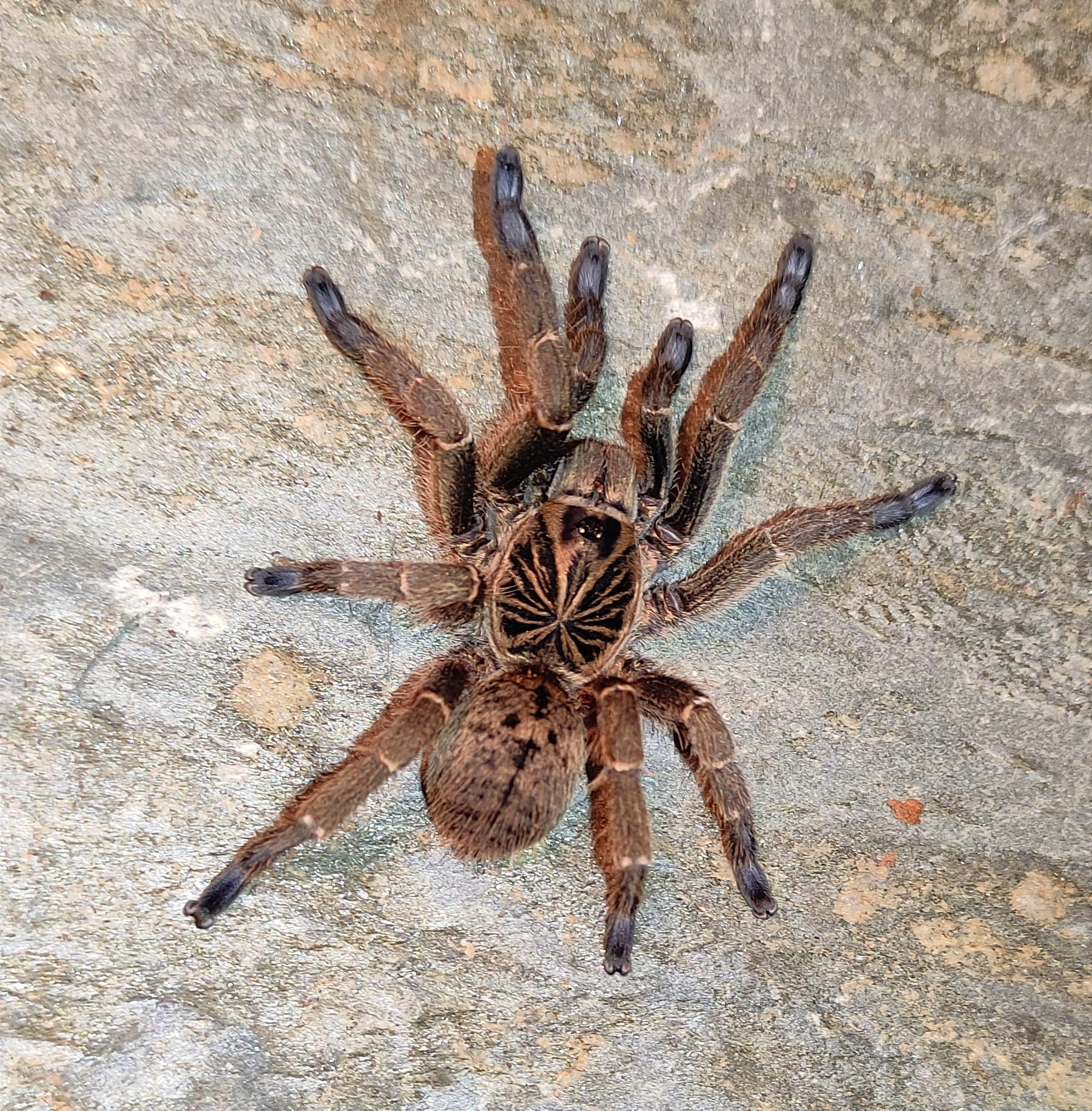
Species: Idiothele mira
Common name: Blue Foot Baboon
Native range: South Africa (KwaZulu-Natal)
Temperature: Room temperature; tolerates 27–30°C with a 2–3°C drop at night
Humidity: 75–80%
Adult size: Female reaches 3–4 cm BL
Lifestyle: Fossorial (trapdoor builder)
Speed: Fast
Venom potency: Moderate
Temperament: Defensive when disturbed
Recommended for: Experienced keepers
Notes: Not CITES-listed; no captive-bred documentation required
Idiothele mira
product unavailable
Description
Idiothele mira comes from the humid forests and grasslands of KwaZulu-Natal, South Africa — a fossorial species that announces itself with an unlikely detail: feet the colour of a clear winter sky, set against a body of deep, almost lacquered brown. The hobby name Blue Foot Baboon lands exactly right, because those cobalt tarsi are not subtle. They catch the eye the moment the animal moves, and they stay with you long after. What makes Idiothele mira genuinely remarkable, however, is not the colour alone — it is what the animal does with the silk it spins over the entrance to its burrow.
The trapdoor is the species. Idiothele mira constructs a hinged lid of silk and substrate over its burrow entrance, a piece of engineering most keepers have to see to believe. It hunts purely by ambush — detecting vibration, lifting the door, and striking in a movement almost too fast to follow. This is an Old World fossorial with the reflexes and the defensive temperament to match: quick, decisive, and not inclined toward patience when disturbed. Expect a spider that spends most of its time underground and surfaces entirely on its own terms.
The enclosure should put that behaviour first. Provide at least 10 cm of substrate — a lightly moistened mix of coconut fibre and topsoil works well — deep enough for Idiothele mira to excavate and seat its trapdoor properly. Include a water dish, and mist occasionally to hold humidity at a moderate level without saturating the substrate. Room temperature is sufficient. The reward for getting the setup right is the trapdoor itself: given suitable conditions, most individuals build one within weeks, and once it is in place it becomes the centrepiece of every observation session.
Idiothele mira suits the keeper who finds ambush mechanics and burrow architecture at least as compelling as colour — and here, improbably, you get both. The blue feet are a bonus that stops making sense the longer you think about it and never quite stops being surprising. Most collectors who acquire this species hold onto it for years, not because it demands attention, but because every time the trapdoor lifts it feels like catching the animal in the middle of something private.