






 Choose language
- Spiders
- ANIMALS
- Arachnids (Arachnida)
- Spiders (Araneae)
- Tarantulas (Mygalomorphae)
- Psednocnemis spp.
- Diplura spp.
- Spinosatibiapalpus spp.
- Acanthogonatus spp.
- Acanthoscurria spp.
- Amazonius spp.
- Ami spp.
- Anquasha spp.
- Aphonopelma spp.
- Aspinochilus spp.
- Augacephalus spp.
- Avicularia spp.
- Birupes spp.
- Bonnetina spp.
- Brachypelma spp.
- Bumba spp.
- Caribena spp.
- Ceratogyrus spp.
- Chaetopelma spp.
- Chilobrachys spp.
- Chromatopelma spp.
- Cilantica spp.
- Citharacanthus spp.
- Coremiocnemis spp.
- Cyclosternum spp.
- Cyriocosmus spp.
- Cyriopagopus spp.
- Davus spp.
- Dolichothele spp.
- Encyocratella spp.
- Ephebopus spp.
- Euathlus spp.
- Eucratoscelus spp.
- Eupalaestrus spp.
- Fufius spp.
- Gorgyrella spp.
- Grammostola spp.
- Guyruita spp.
- Hapalopus spp.
- Haploclastus spp.
- Haplocosmia spp.
- Haplopelma spp.
- Harpactira spp.
- Heteroscodra spp.
- Heterothele spp.
- Holothele spp.
- Homoeomma spp.
- Hysterocrates spp.
- Idiothele spp.
- Iridopelma spp.
- Kochiana spp.
- Lampropelma spp.
- Lasiocyano spp.
- Lasiodora spp.
- Lasiodorides spp.
- Linothele spp.
- Lyrognathus spp.
- Megaphobema spp.
- Monocentropus spp.
- Neischnocolus spp.
- Neoholothele spp.
- Neostenotarsus spp.
- Nhandu spp.
- Omothymus spp.
- Ornithoctoninae spp.
- Ornithoctonus spp.
- Pamphobeteus spp.
- Pelinobius spp.
- Phormictopus spp.
- Phormingochilus spp.
- Phrixotrichus spp.
- Poecilotheria spp.
- Psalmopoeus spp.
- Pseudhapalopus spp.
- Pseudoclamoris spp.
- Pterinochilus spp.
- Selenocosmia spp.
- Sericopelma spp.
- Tapinauchenius spp.
- Taksinus spp.
- Tapinauchenius spp.
- Theraphosa spp.
- Theraphosidae spp.
- Theraphosinae spp.
- Thrigmopoeus spp.
- Thrixopelma spp.
- Tliltocatl spp.
- Typhochlaena spp.
- Urupelma spp.
- Vitalius spp.
- Xenesthis spp.
- Ybyrapora spp.
- True Spiders (Araneomorphae)
- Velvet Spiders (Eresidae)
- Macrothele spp.
- Liphistius spp.
- Tarantulas (Mygalomorphae)
- Scorpions (Scorpiones)
- Spiders (Araneae)
- Insects - for feeding
- Arachnids (Arachnida)
- Scorpions
- Accessories
- Books
- Centipede
- Millipede
- Cockroaches
- New products
- Products on sale
Currency

€32.00
Regular price:
€40.00

€42.50
Regular price:
€50.00
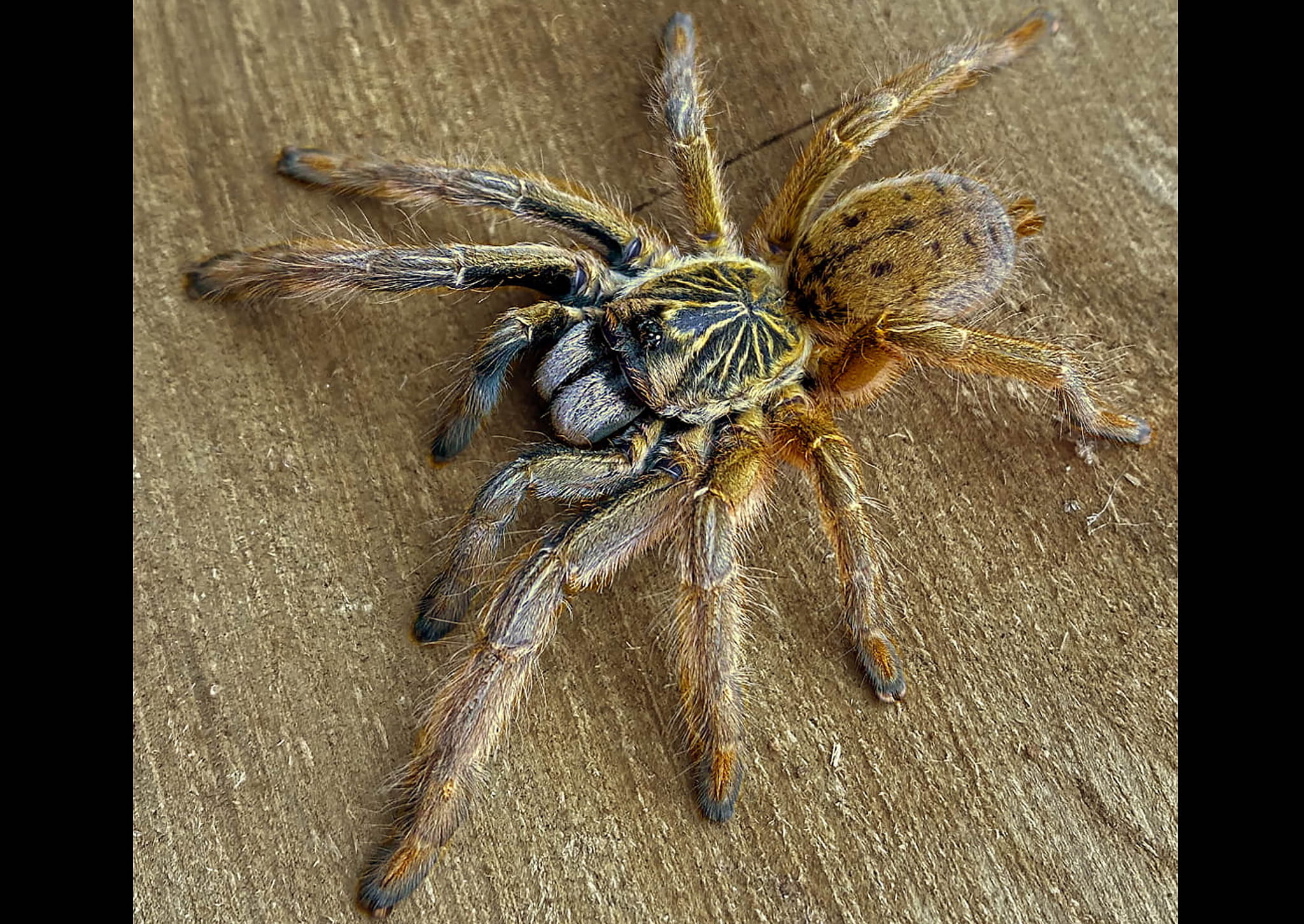
Species: Augacephalus ezendami
Common name: -
Native range: East Africa (Mozambique, Tanzania)
Temperature: 25–28°C, with a 2–3°C drop at night; room temperature is also fine
Humidity: 60%
Adult size: Female 4.5–5 cm body length, leg span up to 15 cm; male up to 3.5–4 cm body length
Lifestyle: Terrestrial
Speed: Fast
Venom potency: Potent
Temperament: Defensive when disturbed
Recommended for: Advanced keepers
Notes: Not CITES listed
Augacephalus ezendami
product unavailable
Description
Augacephalus ezendami comes from the drier reaches of East Africa — Mozambique, Tanzania and the surrounding region, where open savanna gives way to dry woodland and the ground is the only geography that matters. In the wild this fossorial species seals its burrow with a hinged plug of silk and packed earth, placing it in a small club of tarantulas that build a literal door at the threshold. The body reads the same story as the habitat: dark brown with a faint olive sheen across the carapace, heavily set, with legs shaped for excavation rather than sprinting.
In the enclosure Augacephalus ezendami keeps its own hours. For most of the day it stays underground, sometimes extending only the tips of its front legs past the burrow entrance — patient, almost geological in its stillness. When prey wanders close enough, that patience collapses into something instant and decisive. Few ambush hunters in the family are this surgical, and the temperament matches the strategy: not given to unprovoked displays, but very clear about where the boundary sits. Handling is not part of the relationship this species offers.
The one thing the enclosure must get right is depth. At minimum 8 to 10 cm of a lightly moist mix of coconut fibre, peat and topsoil, packed firmly enough to hold a tunnel, is what unlocks the behaviour you actually bought this animal for. Room temperature is fine, with moderate humidity and a water dish for adults. When offering prey, drop it near the burrow entrance rather than across the enclosure — that small detail is the difference between a fed spider and seeing the trapdoor strike, which is genuinely one of the more arresting things the hobby has to offer.
This is a species for the keeper who has moved past surface-level fascination and wants to study something genuinely unusual. The trapdoor construction and the strike that follows are not found in many other theraphosid genera, and they reward the kind of patient, attentive watching that experienced keepers come to value more than flashy colour or constant activity. Give Augacephalus ezendami the substrate depth it needs, and years from now you will still find yourself crouched by the enclosure at night, waiting for that plug to lift.