






 Choose language
- Spiders
- ANIMALS
- Arachnids (Arachnida)
- Spiders (Araneae)
- Tarantulas (Mygalomorphae)
- Psednocnemis spp.
- Diplura spp.
- Spinosatibiapalpus spp.
- Acanthogonatus spp.
- Acanthoscurria spp.
- Amazonius spp.
- Ami spp.
- Anquasha spp.
- Aphonopelma spp.
- Aspinochilus spp.
- Augacephalus spp.
- Avicularia spp.
- Birupes spp.
- Bonnetina spp.
- Brachypelma spp.
- Bumba spp.
- Caribena spp.
- Ceratogyrus spp.
- Chaetopelma spp.
- Chilobrachys spp.
- Chromatopelma spp.
- Cilantica spp.
- Citharacanthus spp.
- Coremiocnemis spp.
- Cyclosternum spp.
- Cyriocosmus spp.
- Cyriopagopus spp.
- Davus spp.
- Dolichothele spp.
- Encyocratella spp.
- Ephebopus spp.
- Euathlus spp.
- Eucratoscelus spp.
- Eupalaestrus spp.
- Fufius spp.
- Gorgyrella spp.
- Grammostola spp.
- Guyruita spp.
- Hapalopus spp.
- Haploclastus spp.
- Haplocosmia spp.
- Haplopelma spp.
- Harpactira spp.
- Heteroscodra spp.
- Heterothele spp.
- Holothele spp.
- Homoeomma spp.
- Hysterocrates spp.
- Idiothele spp.
- Iridopelma spp.
- Kochiana spp.
- Lampropelma spp.
- Lasiocyano spp.
- Lasiodora spp.
- Lasiodorides spp.
- Linothele spp.
- Lyrognathus spp.
- Megaphobema spp.
- Monocentropus spp.
- Neischnocolus spp.
- Neoholothele spp.
- Neostenotarsus spp.
- Nhandu spp.
- Omothymus spp.
- Ornithoctoninae spp.
- Ornithoctonus spp.
- Pamphobeteus spp.
- Pelinobius spp.
- Phormictopus spp.
- Phormingochilus spp.
- Phrixotrichus spp.
- Poecilotheria spp.
- Psalmopoeus spp.
- Pseudhapalopus spp.
- Pseudoclamoris spp.
- Pterinochilus spp.
- Selenocosmia spp.
- Sericopelma spp.
- Tapinauchenius spp.
- Taksinus spp.
- Tapinauchenius spp.
- Theraphosa spp.
- Theraphosidae spp.
- Theraphosinae spp.
- Thrigmopoeus spp.
- Thrixopelma spp.
- Tliltocatl spp.
- Typhochlaena spp.
- Urupelma spp.
- Vitalius spp.
- Xenesthis spp.
- Ybyrapora spp.
- True Spiders (Araneomorphae)
- Velvet Spiders (Eresidae)
- Macrothele spp.
- Liphistius spp.
- Tarantulas (Mygalomorphae)
- Scorpions (Scorpiones)
- Spiders (Araneae)
- Insects - for feeding
- Arachnids (Arachnida)
- Scorpions
- Accessories
- Books
- Centipede
- Millipede
- Cockroaches
- New products
- Products on sale
Currency

€32.00
Regular price:
€40.00

€42.50
Regular price:
€50.00
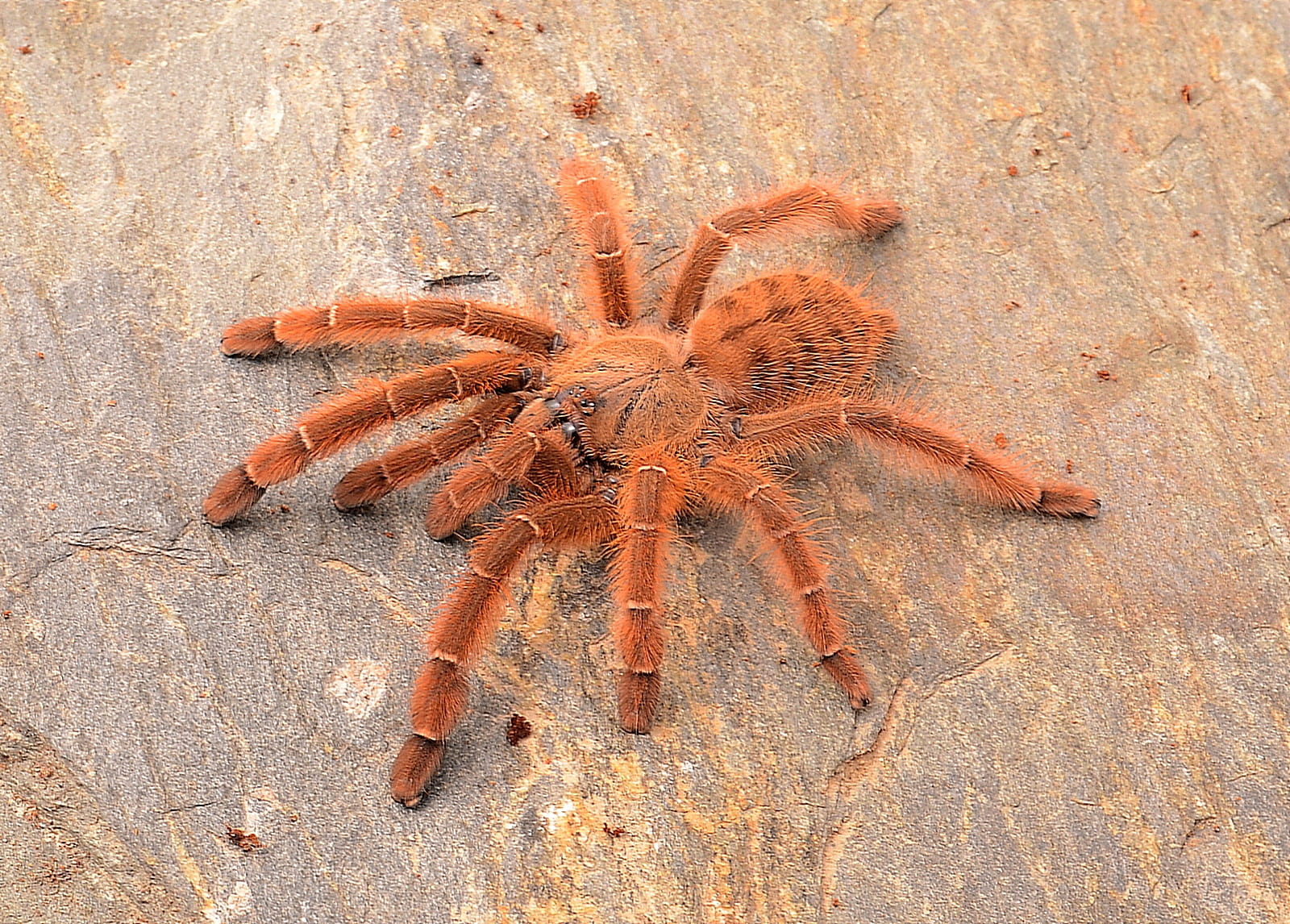
Species: Aspinochilus (ex. Phormingochilus) rufus
Common name: -
Native range: Borneo (Indonesia)
Temperature: 24–28°C
Humidity: 70–80%
Adult size: 6 cm BL
Lifestyle: Fossorial
Speed: very fast
Venom potency: potent
Temperament: defensive, skittish
Recommended for: advanced keepers
Notes: Not CITES listed; no captive-bred documentation required.
Aspinochilus rufus
product unavailable
Description
Borneo — the world's third largest island, blanketed in equatorial rainforest and home to some of Asia's most remarkable arboreal spiders. Aspinochilus rufus, until recently placed in the genus Phormingochilus, emerges from that landscape looking less like a living animal than like a coal fire given eight legs: warm rufous-orange setae laid over a deep, dark ground, the contrast sharp enough to stop you mid-reach before you've even opened the enclosure. In the wild, Aspinochilus rufus occupies tree hollows and crevices in bark high above the forest floor — and in captivity, it behaves as though it has never forgotten that elevation.
Fast is the word keepers reach for first, but it undersells what Aspinochilus rufus actually does: it disappears. A disturbed individual can close the distance between an exposed position and the back of a silken tube retreat before the observer has registered the movement. This is unambiguously a display animal, not a handling specimen, and that framing should be settled before acquisition rather than after. Given space and security, Aspinochilus rufus repays the hands-off approach generously, constructing dense, layered webbing that gradually transforms a well-designed enclosure into something resembling a cross-section of the tree it would otherwise inhabit. Watching it take prey is, on its own, worth the setup.
The enclosure must be oriented vertically: height matters far more here than floor area. Cork bark, cork tubes positioned upright, and vertical lengths of wood give Aspinochilus rufus the scaffolding it needs to express its natural architecture. A silken tube retreat anchored high is not a luxury — it is the foundation of the animal's behavioural repertoire. Regular misting keeps humidity appropriately elevated, but cross-ventilation is the one requirement that cannot be compromised; stagnant moisture will undo every other care decision. A water dish on the substrate and a temperature in the 24–28°C range complete the picture. The substrate itself should stay slightly damp, never wet.
Aspinochilus rufus is a species for the keeper who has already spent time with Old World arboreal theraphosids, knows what that temperament demands, and has come to regard that demand as part of the appeal. Few arboreal spiders from Borneo carry colour this warm; fewer still build webbing that rewards months of patient observation the way this one does. Years in, what you'll remember isn't a single moment — it's the slow accumulation of silk against bark, and the quiet certainty that the enclosure is, in every sense that matters, alive.